
Asking road users what they need

July 03, 2012

BC HighwayCams: "Know before you go"

“Where would you like to see a BC HighwayCam in our province to better help you know before you go?”

It’s an important question indeed – for working drivers and the public – and throughout June it was TranBC‘s monthly survey question. These cameras contribute to the safety of all road users who can go online, see road conditions, and plan their routes.

TranBC is an online education, awareness, and engagement initiative of the BC Ministry of Transportation and Infrastructure. It was on Twitter that I first saw a link to their HighwayCam survey – and I wondered how many participated.

I asked Russel Lolacher, director of social media for the BC Ministry of Transportation and Infrastructure’s Business Management Services. He said (on June 21) they had received more than 500. (Update: “FYI, we ended up with over 700 responses to the web cam survey. Great feedback as to where people want new cams,” said @TranBC via Twitter on July 3).

“BC highway webcams are one of our most popular online services here at the Ministry of Transportation, and to better serve the public, we want to engage those that use them,” Russel said, via email. “We would like to hear from professional drivers due to their experience, travelling our transportation consistently. Their knowledge is invaluable, as is their input.”

Starting conversations and building relationships

TranBC is using many platforms to connect with their stakeholders – i.e., this survey, along with Facebook, Twitter, YouTube, and more (see below). I asked Russel if he had any advice for organizations who want to use this social media technology to get input from their own stakeholders.

“The best piece of advice I would recommend is not to look at it as using technology, but rather as hearing from people. The social platforms you’ve just mentioned are just tools, it’s the human engagement that matters most regardless of the medium you use,” Russel said.

“To be successful in hearing from your stakeholders, an organization has to look at it as an ongoing conversation and relationship building, rather than ‘one-offs.’ Through our social channels such as TranBC and DriveBC, we are working to build a long-term presence as the online BC Transportation resource for the travelling public.”

Each month, TranBC is launching a different survey. In July, the public is invited to share their views on how Transportation and Infrastructure can improve its level of customer service.

You can find TranBC on Twitter, Facebook, Flickr, Youtube, Foursquare, and – most recently – Pinterest.

Saving the boss

October 11, 2011

Photo credit: thepretenda's Big Truck Sequence on Flickr

Here’s another story from Petr, a former mechanic who once had a job changing tires of trucks stranded on the freeways of Quebec and Ontario. He was an apprentice to Tony, who was “very, very tough.”

Once they were called in the middle of the night to a huge transport vehicle stranded near Dorval Airport.

“It looked like a crippled yellow dinosaur, kneeling by a small curb. To lift anything of that magnitude and get the wheels off, you need two jacks,” Petr explained. “You stack up large pieces of flat wood under the other jack and alternate until you have that sucker about two feet high.”

“Truckasaurus” comes down

Tony was under the rear axle, half-way through the lift, when the vehicle began to shake. Luckily Petr was paying attention.

Photo credit: gbergin on Flickr

“The wind was blowing pretty hard from the airport, and the dinosaur started rocking. I threw down the next two wooden blocks and shouted. All I could think to say was: ‘Tony, come out, it’s shaking!’

“I was tugging at his snow gear. He was on his left side when truckasaurus came down. It flexed the planks stuffed under the axle to keep it from going all the way to the ground, but Tony was still on his side. As soon as it bounced back up, he kind of flopped onto his back, and the monster rested with about half an inch to clear his chest. I pulled him out by his parka that was snagged on the big yellow axle,” Petr said.

Photo credit: Tom Lee KelSo on Flickr

“Tony was one of those guys who took six arrows in old Westerns – and he really was that tough. He didn’t die. He just got tougher and meaner. But that night, he went home and I had to drive his massive red truck because he couldn’t turn the wheel.”

A similar tale

Luckily Tony was relatively unhurt compared to this WorkSafeBC Hazard Alert that describes how a worker suffered a broken pelvis and tailbone after being crushed under heavy mining equipment.

Thanks again to Petr for sharing his story. If you have a story to share about safety in the workplace, please email me.

Sharing streets on foot, bike, car

September 28, 2011

Getting to work can be a safety issue in itself – when you think about cyclists, motorists, and pedestrians sharing so much of the same space. The City of Vancouver reports 3,500 workers ride bicycles to jobs in downtown Vancouver each day. That’s a lot of road-sharing! This video shows how they’re dealing with it in Boston.


Watch this video on YouTube

The power of a tire explosion

September 27, 2011

Photo credit: John Vachon, USA, 1943, Library of Congress Prints and Photographs Division Washington, D.C.

Tires can explode with deadly force – for a few different reasons.

Recently I met a former mechanic named Petr at my favourite local coffee shop. He told me about a tire explosion he experienced a few years ago when he was working as a mobile mechanic for his dad’s company, rescuing broken-down trucks from the highways of Ontario and Quebec.

One night he was dispatched to fix a flat on a big truck, when the driver reported that his air brakes had failed earlier. Petr wasn’t sure what the driver was talking about, since it was fairly difficult to re-attach air brakes. He removed the wheel to fix the flat and noticed the brake line was “just hanging back there.”

The driver had gone all the way from Mississauga to Montreal – 538 kilometres – with a locked brake. Not good. Petr told me what happened next.

“I had the flat tire on the tailgate of my truck, inflating, and covered in soap to see where the flat is,” Petr wrote, via email. “I was in the driver’s seat, filling out a work order when my world jumped and I had a face-full of steering wheel. The tire had exploded and somehow threw itself a good six feet next to where the driver had been.”

Photo credit: Bryan Costin on Flickr

It turns out the tire had been held in place by the locked brake. The rim of the wheel spun inside it all that time, creating so much heat from friction that it “completely annihilated the metal cords that held the tire together,” Petr explained.

Thankfully no one was hurt – even though the driver was, as Petr put it: “pale as a ghost with a completely empty colon.”

Tire explosions can be deadly

Tires can exploded for a number of reasons. Over-inflating causes explosions, as can under-inflating tires – which leads to damage and irregular wear. Improper fitting onto rims is also dangerous.

These videos show how dangerous tires can be – so please be careful at work and on the road. Thanks again to Petr for telling me about his experience, and if you have a story to share, email susan@speakingofsafety.ca.

Slow down in the cone zone

July 26, 2011

Slow down in the Cone Zone

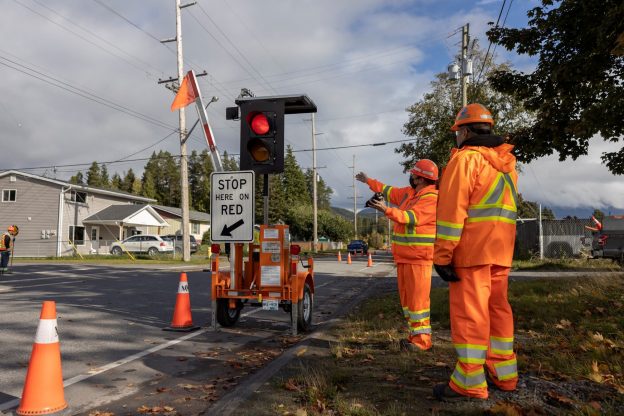
When you enter the “Cone Zone,” you should reduce your speed, pay attention, and be respectful of the roadside workers and their workplace.

That’s the message from Work Zone Safety Alliance. Their new roadside worker safety awareness campaign is aimed to protect thousands of workers on the roads – and I’m glad to see it!

We need as much attention as possible directed at this group of vulnerable roadside workers that includes municipal workers, landscapers, flag people, tow-truck drivers, road-construction and road-maintenance workers, telecommunications and utility workers, and emergency and enforcement personnel.

In the last 10 years, 386 WorkSafeBC claims were made by workers — typically working in Cone Zones — who were struck by motor vehicles. That’s way too many injuries, which is why it’s good to see all these organizations working together to reduce them:

* BCAA Road Safety Foundation
* BC Ambulance Service
* BC Construction Safety Alliance
* BC Flagging Association
* BC Hydro
* BC Landscape and Nursery Association
* BC Municipal Safety Association
* BC Road Builders and Heavy Construction Association
* FortisBC
* ICBC
* Ministry of Public Safety and Solicitor General
* Ministry of Transportation and Infrastructure
* Telus
* The Community Against Preventable Injuries
* Vancouver Fire and Rescue Services
* Lower Mainland police
* WorkSafeBC

For more info, or to download a campaign poster, visit Slow Down in the Cone Zone from WorkSafeBC. Drivers, please pay attention to this important message. Too often people speed through, thinking of where they are going, without caring enough about the people they pass. It’s time to change that!

Motor vehicle deaths on decline in Canada

February 15, 2011

Queen Elizabeth Way, outside Oakville, Ont. Photo by: chapstickaddict on Flickr

I first heard the news from my Driver Safety Canada group on LinkedIn. Transport Canada announced: “Lowest death toll on Canadian roads in almost 60 years”.

In 2008, 2,419 road users died in Canada, down from 2,761 in 2007. I thought about why these numbers are down (but still too high) and it seemed to me we owe credit to the people who’ve been advocating for road safety.

Who can we thank?

One important project is the Fraser Canyon Truck Safety Corridor: “BC and Canada’s first designated highway safety corridor” established in 2005. I did some writing for this project back then, and I always think of it now when I drive this highway east of Vancouver.

A highway safety corridor is “a stretch of highway that experiences a higher than average number of motor vehicle crashes, injuries or fatalities.” ICBC sponsored the installation of rumble strips on the road. The strips mark the edges of traffic lanes and they make a rumbling sound when your tires pass over them. I’m sure they’ve made a big difference and prevented lots of crashes, along with new signage, traffic routing, and road improvements.

Still too many dying

Photo credit: kazuaki.h on Flickr

That lower total of fatalities for 2008 (2419 people) is still far too high. Reducing them further is an ongoing goal shared by these dedicated drivers of change in BC:

1. DriveBC - up-to-date road conditions listed, managed by the BC Ministry of Transportation and Infrastructure – with a good Twitter feed of road safety updates.

2. Shift into Winter – a website of road safety tips from:

* ICBC
* RCMP
* BC Trucking Association
* BCAA Traffic Safety Foundation
* BC Ministry of Transportation and Infrastructure
* BC Road Builders and Heavy Construction Association
* WorkSafeBC

3. Staying safe on BC’s resource roads – A video series for for workers, created by WorkSafeBC with the assistance of the forestry, petroleum, and mining industries.

4. Preventable.ca – a community raising awareness of preventable injuries, including:
* BCAA Traffic Safety Foundation
* Insurance Bureau of Canada
* London Drugs Ltd.
* BC Ministry of Labour
* Pacific Blue Cross
* TELUS
* WorkSafeBC

This is not an exhaustive list – so please let me know who else to thank for efforts. I hope everyone who’s been working for road safety will see the Transport Canada stats, pat themselves on the back, and then keep working – along with the rest of us drivers.

“Slow Down” posters hit hard

July 28, 2010

A province-wide poster campaign reminds drivers to “Slow Down” as they pass through road construction zones.

The photos are of real people – not actors – and they aim for the heart, with messages like: “Slow down. My grandpa works here.”

More than 50 families volunteered to use their images for the campaign and I saw my first one last year by the Canada Line project in Richmond. The smiling images of the working mom with her cute kids, looked out at the road, reminding drivers: “My mom works here.”

Human beings work here

This sends a powerful message. These workers are human beings with families. They are not just annoying obstacles slowing you down.

The current “Slow Down” campaign reminds me of a conversation I had with a safety manager on the Lions Gate Bridge project in 2000. Her name was Nicky Wilson and she said traffic was the biggest risk to workers.
Read more

Real workers rap at Dominion Virginia Power

July 21, 2010

Video by Dennis McDade – a Virginia Power lineman by day, songwriter / rap artist by night.