

The path to proper machine safeguarding
August 09, 2012

From WorkSafeBC’s Safeguarding Machinery and Equipment
Machines without proper safeguarding put workers at risk of amputation, disfigurement, and death.
“I’m often summoned in the aftermath of workplace accidents – everything from fingers torn off to people crushed in presses,” said Ian Rood, quoted in an article in WorkSafe Magazine.
Ian is the owner of UBSafe Inc., a company that specializes in safeguarding and risk assessment. He trained WorkSafeBC officers to spot and address safeguarding violations. He said that, in the past, officers tended to write up violations of lockout, when the most important issue was actually safeguarding.
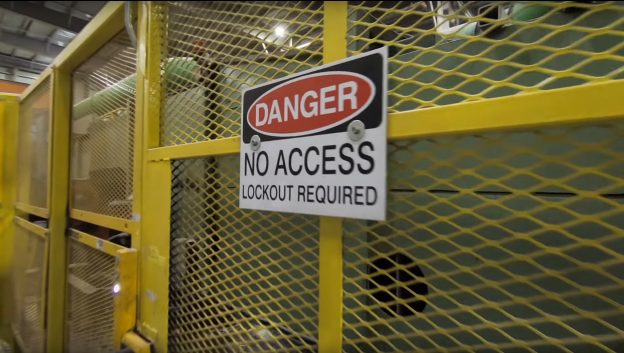
“Most of the time, prior to the lockout violation, there’s a safeguarding violation,” Ian said. “The two are intertwined, but lockout is for maintenance. Safeguarding is for operation.”
An in-depth description of the differences can be found in Safeguarding Machinery and Equipment by WorkSafeBC.
Ian told WorkSafe Magazine that “about 70 percent of places we visited either have wildly inappropriate safeguards or the equipment isn’t safeguarded at all… This applies to everything from small shops to large assembly lines.”
Safeguarding workshop at Make it Safe Conference
Preventing machine-related injuries is the focus of Ian’s upcoming workshop, Machine Safeguarding for Tradesmen (practical and technical), at the Make it Safe Conference in Vancouver on September 21 and 22.
He said he’ll start with an explanation of BC’s regulatory requirements for safeguarding and lockout, covering the differences between production and maintenance activities. Then he’ll go into the concept of risk assessment, which, he said, “tells you, based on your level of risk faced, what the minimum acceptable level of control is.”
Ian described the outcome of his workshop, which is ideal for plant managers, operations managers, OHS managers, and others in similar roles.
“They will take away understanding of three different risk assessment models and which one fits their scenario better,” Ian said. “They won’t be able to do their own risk assessments but they’ll come away understanding the concept… It’s a good overview at the management level – the awareness level stuff that gets you on the right path.”
More info
Worker lost finger in wood-planing machine from the UK’s Health and Safety Executive
Safety facts: Power on maintenance from FIOSA-MIOSA
Lockout lacking, guard removed
October 06, 2011
A 41-year-old man in England was seriously injured – but thankfully survived – after he was pulled into the unguarded, rotating parts of a machine.
It gave me shivers to read the story in the Health and Safety Executive blog about Adrian Taylor, a worker in the West Midlands – father of two, same age as my brother.
Adrian had been adjusting the rollers on a machine that makes metal shelving components from steel coil. The machine started accidentally and his high-viz vest and jacket were sucked into the rollers.
“He was pulled forward into the machinery and sustained a number of injuries including a cut to the back of his head, cuts above his right eye and on his back, a swollen cheek bone, bruises on his right arm and a puncture hole in his right elbow,” reads the HSE post.
“HSE’s investigation into the incident found that a fixed guard, which would have protected workers from dangerous parts of the machine, had been removed at least two to three years previously.”
Importance of lock-out
Adrian’s story underscores the importance of lockout – defined in BC’s OHS Regulation as: “the use of a lock or locks to render machinery or equipment inoperable or to isolate an energy source in accordance with a written procedure.”
In other words, lockout stops a machine from starting by accident. WorkSafeBC is producing some new resources on lockout for manufacturers, and they already have lots of lockout resources for many other industries that use big machines – kitchen choppers, meat grinders, drilling rig hammers, dump trucks, punch presses, and lots of other things that shouldn’t turn on while you are adjusting them!
Here are more resources on lockout – and if you have any to add, please share them in the Comments section below.
Lockout a booklet from WorkSafeBC
Lockout from the Industrial Accident Prevention Association
Using lockout and tagout procedures to prevent injury and death during machine maintenance, a tip sheet from NIOSH
Did language barrier lead to worker’s death?, article by Alex Irwin in Manufacturing Weekly


