
Working in bear country

November 02, 2010

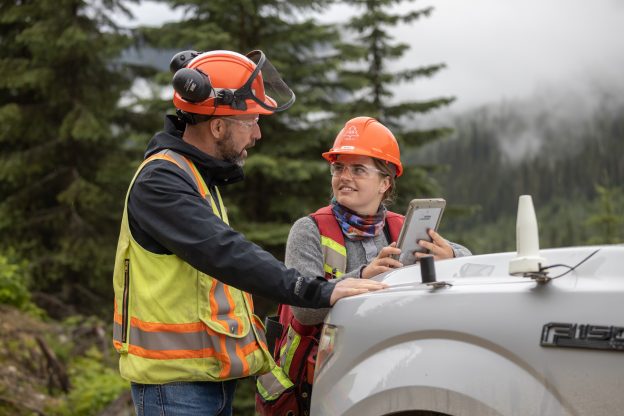
B.C. archaeologist Shannon Cameron

BC archaeologist Shannon Cameron takes precautions every time she goes to work in the woods. But one day, she and her coworker met a bear whose curiosity outweighed his instinct to avoid humans.

“He was within 15 feet and he was standing up on his hind legs and huffing. There’s specific noises and facial expressions they make when they’re going to charge, and my crew member and I were doing everything we could to look as big as possible,” she told me.

“We were waving our arms and clapping and hollering and setting off bear bangers and bear spray and finally the bear decided he didn’t want anything to do with it and he turned around and walked away. That’s as close as I ever got.”

As archaeologists, Shannon and her colleagues look for evidence of past human activity on pieces of land used by foresters, geologists, and other industries. The first thing they do – with respect to wildlife – is make a lot of noise to announce their arrival. They bang shovels and do “bush calls” to let animals know humans have entered their territory. Once they get to work, they keep talking to one another if they are spread out, to keep their presence known.

Bear tracks. Photo supplied by Shannon Cameron

“You’re pretty focused on what you’re doing on the site, trying to get it done,” Shannon said. “There were things you had to do in that environment, like not bringing certain foods like chicken wings or ribs in your lunch and making sure all your food is well-sealed.”

Shannon said they also carry bear bangers (i.e. small explosives that scare bears away), bear spray, and a rifle for shooting into the air. She said workers in the area – foresters, geologists, biologists, and archaeologists – inform each other about animal sightings.

“Knowing there’s a mama bear with cubs in the area is the most concerning thing because you know they will be very protective and they’ll have bigger boundaries than they normally do,” she said.

Shannon said awareness is the best prevention.

Photo credit: emples on Flickr

“It’s being aware of your surroundings and trying to be respectful of it. If you do that, you really minimize your chance of having those close encounters,” Shannon said, describing how you can keep the environment safe for other humans who arrive after you.

“You don’t leave all your food wrappers or feminine hygiene products laying around. If you minimize your impact and let everything know where you are in the bush, you’re probably not going to have that many incidents.”

Even one close-up incident would be more than enough for me, but luckily there’s more information on minimizing the risks of bears in the woods. Check out Beware of bears and be prepared and Training of workers with respect to bears.

Removing danger trees killed by pine beetles

September 14, 2010

Recreation officer Doug Harris and recreation technician Michelle Wiebe in 100 Mile House, B.C., August 2010

If a tree falls in the forest – better that it’s not beside someone’s tent or picnic table.

Thanks to the mountain pine beetle invasion, thousands of trees in B.C. are designated as “danger trees” because they have severe lean, root damage, or rotten branches that make them likely to fall. For safety’s sake, these trees are being removed from within striking distance of campsites, picnic tables, outhouses, and parking lots.

“Just because it’s dead, doesn’t make it a danger tree because it’s still got good roots,” said recreation officer Doug Harris, who has overseen the removal of 14,000 trees since 2003 from recreation sites in his region. Read more

Get your emergency eye wash together

September 07, 2010

Is your emergency eye wash up to par? If not, you’re not alone, says Del Goudreau – an occupational first aid attendant who treats and transfers injured workers to hospital from remote industrial sites.

Del in his mobile treatment and transport truck

Del visits forestry, construction, and manufacturing sites througout southwest B.C. and Vancouver Island. He wrote a Letter to the Editor that appeared in the July/Aug 2009 issue of WorkSafe Magazine – asking employers to make sure workers have access to proper eyewash supplies.

Del’s letter said, “I never see adequate emergency treatment measures or resources to assist injured workers when their eyes have been exposed to chemicals….” That surprised me. I phoned Del for more details.

“You go to some sites and they don’t even have an emergency eyewash, or it’s not in a conspicuous place that’s accessible,” he said. “At best, they’ll have an emergency eyewash bottle which is only one litre of fluid – and most of the time, I don’t know what the fluid is. It’s not very well-marked and it’s not maintained.”

That’s bad news for anyone who gets chemicals or particles in their eyes. Flushing with water ASAP makes a big difference. In some cases, it can save vision.

Workplace rules and regs on eyewash vary among jurisdictions. Here in British Columbia, Canada, the WorkSafeBC Regulation Part 5 Chemical Agents requires employers to select appropriate eye wash facilities: “based on an assessment of the risks in each workplace.”

Treeplanting lessons learned from experience

August 31, 2010

Treeplanter Kelly, courtesy of the National Portrait Gallery, Photo credit: oursonpolaire on Flickr

Treeplanting is grueling work, so it’s no surprise that treeplanters are prone to injuries. According to WorkSafeBC, planters’ repetive-strain claims alone cost more than $870,000 and 8,621 lost days of work between 2003 and 2007.

I’ve heard many stories from planters who finished their season with aches, pains, and more serious injuries. One is Michael Lien, who today works in the film industry, but in the past planted trees every spring for a dozen years.

One year, Michael finished the season with a herniated disk in his lower spine. He said the initial injury happened on the second day of the season – on a cold day in April, in treacherous terrain, when he was loaded with heavy bags. He stepped between two unwieldy logs, lost his balance, and felt the trunk of his body twist as he fell.

“I didn’t feel the pain fully until almost October. It was a really heavy season, and then my body settled, and it was phenomenal because I couldn’t sit,” he said, describing an excruciating pain that ran through his butt cheek, down his leg.

At first Mike’s doctor thought the pain would go away on its own, but it didn’t. He couldn’t return to school at Simon Fraser University because sitting was too painful. The pain kept him from sleeping, and he asked his doctor to investigate further. A CT scan revealed a herniated disk in his lower back and he needed an emergency surgery to repair it before it ruptured.

Michael Lien skating - great exercise for core strength. Photo by Richard Lien

Thankfully Mike recovered well, jogging again four months later, and planting again the next spring. He started that next season with strong core muscles, and his company’s first aid attendant reminded him and his colleagues via e-mail to do certain stretch and strengthening exercises pre-season.

“My injury was definitely because I was this guy who was generally in pretty good condition but on a really cold day on the second day of the season, I took this big fall,” he said. “If it was two weeks into the season or three weeks in, I probably wouldn’t have hurt myself.”

For more information on fitness programs for treeplanters, see Tree-Planter.com – the online community for Canadian treeplanters, and the article “Ground Rules” in WorkSafe Magazine, July/August 2009.