

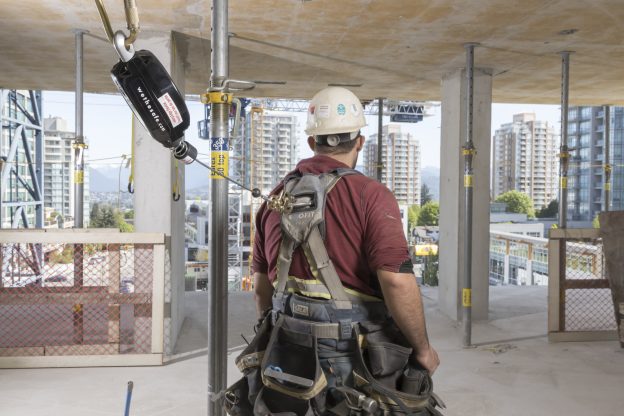
Inspecting safety in residential construction

September 11, 2012

Image from WorkSafeBC

“Falls from heights are a leading cause of serious injuries for workers in the residential construction industry,” says Al Johnson, WorkSafeBC director of Worker and Employer Services in this press release.

That’s why WorkSafeBC is stepping up its number of safety inspections at residential construction sites throughout the province as part of its Stay On Top Enforcement Blitz. WorkSafeBC officers are looking at fall protection, walkways, ladders, planning, and supervision. Their goal is to do 100 additional inspections each month (from June 25 to November 3) and their data will be used to develop safety solutions.

I checked in with WorkSafeBC to see how it’s going – and received some early numbers, as of Aug. 1. During that time, 30 Prevention officers wrote 133 inspection reports that contain 335 corrective orders. The top 7 orders address:

Obligation to use fall protection
Employer general duties (instruct, train, supervise)
Compliance reports
Written fall protection plan
Stairways equipped with handrails
Hierarchy of fall protection (guardrails)
Floor and roof openings

In other regions…

A similar initiative is underway on Prince Edward Island – where on July 3 they started a “a two year, zero tolerance campaign to ensure workplaces are using proper equipment to prevent falls,” according to this CBC story.

PEI also added new training requirements to their fall protection regulation on June 9, 2012.

Bill Reid, director of PEI’s OHS division, told the CBC officers are visiting workplaces across the province to look at the safety of people working at heights.

“What it means for people that are using the fall protection is that when our officer does come on site, if there is violations to the fall protection regulations, or the scaffolding regulations, or workers working at height without protection, we are taking it very seriously,” Reid said, quoted by CBC. “And there will be a lot more stop work orders and potential prosecutions if the violations are flagrant.”

In Ontario, safety inspectors will be focusing on supervision at construction sites in September and October as part of their annual Fall Safety Blitz. The Ontario Ministry of Labour reports that “since 2008, ministry inspectors have conducted more than 345,000 field visits, 43 inspection blitzes and issued more than 560,000 compliance orders in Ontario workplaces.”

In the US, the Stop Construction Falls campaign – is supported by the American Society of Safety Engineers (ASSE), OSHA, and NIOSH.

The UK’s Shattered Lives campaign looks at falls from height in construction, as well as slip and fall risks in other industries. More information from them is available in Falls and trips in construction – Working at height.

Also see WorkSafeBC’s Stay On Top resources

Safety partners talk steep-slope roofing

March 29, 2012

Falling. It’s still one of the biggest risks for people who work on steep slope roofs. This WorkSafeBC report says 117 workers fell from roofs in 2008 to 2010 and on average each of these claims cost $44,518 and resulted in 166 days of lost time.

That’s why the Roofing Contractors Association of BC and its partners – WorkSafeBC, the BC Construction Safety Alliance, Hazmasters, and Ono Work and Safety – hosted a unique, one-day symposium on March 29 for people in the steep-slope roofing industry.

To find out more, I got in touch with HazMasters sales manager Derek Malone, who I met at the Bridging the Gap conference last fall.

“Unique to this symposium is the practical training area at RCABC. While many shows and symposiums are held in hotels this one actually has mock roof tops and a large outdoor area,” Derek said, describing the fall protection systems Hazmasters installed and set up.

“These are temporarily installed on mock roofs that are slightly elevated, allowing for the delegates to touch and see the equipment – like the three-person fall protection system that attaches to the peak of a roof. It installs in minutes and provides anchorage for three workers,” he said.

Find the flaw

Derek said each delegate will perform a hands-on inspection of a harness – some with catastrophic flaws, some with minor flaws, and some ready to use.

“Capital Safety is performing drop tests for the group to show how much force a typical fall can produce,” he said. “Then, to show how much of this force can be absorbed by our modern fall protection systems, like the NANO. Delegates will see how a reduction of 1000 pounds is now achievable with today’s systems.”

I also talked with Roger Sové, the BCRSA’s safety coordinator, who told me more about what delegates would get for their $25 registration fee.

“They will get a better understanding of what their responsibilities are and how they can make safety part of what they do,” he said. “It will enhance their understanding as to why they should work in a safe manner when they hear from other roofers about the consequences of not using proper fall protection systems when they are required. They will have an opportunity to discuss actual fall protection planning and strategy with safety professionals, which will help them to make better decisions on how to work within the regulations and in turn create a safer workplace.”

Thanks to Derek and Roger for telling me more – and congrats on selling out the event.

More fall protection resources

Fall Protection (6-Part Video)
http://www2.worksafebc.com/Publications/Multimedia/Videos.asp?ReportID=34541 from WorkSafeBC

An Introduction to Personal Fall Protection from WorkSafeBC

Fall Protection – Top plate best practice from the BC Construction Safety Alliance

Fall protection pocket card from HazMasters

Accident Alert – Falls from Heights in Construction from WorkSafeBC

High Time – a WorkSafe Magazine story on steep slope roofing from Jul/Aug 2011

What’s wrong with this photo? (Arborist safety)

January 12, 2012

Can you spot 6 dangerous work habits in this photo challenge from WorkSafe Magazine?

The current issue of WorkSafe Magazine features a landscaping scenario in its popular photo challenge, “What’s Wrong With This Photo?”

The staged photo includes at least six hazardous work habits (possibly many more), and your challenge is to identify them and submit your answers to WorkSafe Magazine by January 30, 2012. Your response may be printed in the next bimonthly issue and your name will be put into a draw for a small prize. You can even play online.

Speaking of arborists, I saw an unusual tree incident recently in my neighbourhood. The tree was deemed dangerous because a water pipe had broken beneath its roots, creating potential for it to topple.

Arborist falls tree that needs emergency removal because a major water pipe broke under its roots, S.Main photo

Arborists showed up and climbed the 60-foot tree in beside a townhouse complex and a busy street, with lots of electrical wires above. School children and passers-by stood outside the cordoned-off safety area and watched one of them climb the tree and slice off its branches with a small saw held in the air by ropes.

The worker wore fall protection, eye protection, and other PPE described in the WorkSafeBC publication Safe Work Practices for Certified Utility Arborists: Tree-care work near power lines (PDF 6mb).

What I saw that day looked like a safe operation, unlike the dangerous situation staged in “What’s Wrong With This Photo?” – which you can visit online and try now.

Good luck!

Odd way to change a light bulb

September 01, 2011

Photo credit: Armistead Booker on Flickr

Here’s a story that reminds me of one of those jokes: How many [insert group of people] does it take to change a lightbulb?

In this case, it took one manager, two employees, and some fall protection gear – used innovatively. A worker told me about it via Facebook, after I posted a request for people’s stories about the most dangerous things they’d done at work.

“A light bulb burnt out on the underside of a catwalk approximately two stories up. We didn’t have a ladder, scaffolding, or a lift that was high enough to change the bulb, so my boss puts on a harness, we tie a rope to the D-ring, and two of us lower him down to change the bulb,” he wrote.

How dangerous is that?

I asked if his boss’s request seemed too dangerous at the time.

“It was sketchy, especially since my boss had a good 50 pounds more weight than I,” he wrote. “The two of us had to hold him in mid-air, below the catwalk, for the repair and replacement to be completed. Afterward, we lifted him back to the catwalk.

“It was a fall protection harness, but the rope was only being held by the two of us, not tied off. There was enough rope to reach the ground, about 30 feet down, but if we lost our grip, nothing would have helped. The rope was over-spec for the unusual demand and the railing was up to the task.”

Unusual indeed. I wonder what part of the WorkSafeBC Reg would be in violation if a worker were injured in this situation. Could someone please check for me? The details would not sound good on an incident report – that’s for sure!

Unsafe handling of nail-guns

April 28, 2011

Image: "Townhouse" by pearlblossom/Melissa Samworth on Flickr

A worker on a steep roof slipped and shot himself in the leg with a nail-gun. My friend Darcy Olsen told me about this incident, answering my ongoing request for stories about workplace danger.

It was a hot, humid day in Ottawa in 2005. Darcy and his crew of eight were putting shingles on a multi-phase townhouse re-roof project. Certified in Level 3 Occupational First Aid, Darcy was a skilled tradesman in charge of site safety and emergencies.

“I had gone over the safety issues of using toe-boards on the steep sections with everyone,” Darcy wrote, via Facebook message. “I was on a northern section of roof after setting everyone to their tasks. We had an exuberant young apprentice shingler working another section.”

Toe-boards are part of a roofer’s fall protection system. They are long boards – usually 2×6 or 2×8 – installed along the roof edge.

What happened?

“My lead hand came over and called me to the scene. Young Ben had decided that he didn’t need any toe-boards on his steep section and was working with only his fall-harness,” Darcy wrote. “But, due to the heat, which makes shingles very soft, he slipped in his harness.

“He was using an air-powered roofing coil nailer with 1.25-inch coil nails in it. He had been keeping his finger on the trigger as he moved about – a habit I had previously reprimanded him for. A softened shingle had torn loose under his body weight and, as he slipped, he shot himself just above the left knee with his air nailer – lodging it firmly into the bone.

Image of a nail stuck in a person's leg bone, from WorkSafeBC video: Safe Handling of Nail Guns

“By the time I got to where he was, he was in a semblance of shock, but members of the crew had managed to get him to the 4/12 section of roof. I immediately called 911 for a steep-roof rescue and the fire department came to aid. I stayed with him until the fire department showed up with a telescoping basket to remove him.

“He spent three days in the hospital, and the the time loss for him was only a few weeks. It could’ve been a lot worse if he had shot himself a few inches lower in the kneecap.

“It was a serious safety lesson for the entire crew,” Darcy wrote.

WorkSafeBC’s nail-gun safety series

Darcy’s story made me think of these (fairly gory!) videos on nail-guns and other potentially dangerous power tools: You’re a Pro: Power Tool Series

On a slippery slope without fall protection

March 31, 2011

Photo: Andy Bullock on Flickr

In the 1990s, my brother Bob worked in the Vancouver film industry as a production assistant. At that time, he was in the “young worker” category (15 to 24 years old) and eager to please. In that job, he could be replaced with a moment’s notice. One of his friends had been fired for buying the wrong type of doughnut.

Bob told me about an experience that makes me angry to think about because it’s so dangerous. Thankfully he wasn’t hurt, but it’s still a good example of worst practices.

“I once stood on a slippery roof holding a piece of plywood while a massive snow gun shot fake snow at me to create the illusion of winter,” he told me via Facebook, in answer to my question: “What’s the most dangerous thing you’ve ever been asked to do at work?”

“It was almost impossible, but took every ounce of strength I had to not go flying,” he said. “I think weird stuff like that happens all the time in film because there’s a sort of unwritten thing relating a bit to ‘the show must go on’ or ‘whatever it takes’ mentality in that part of the arts.”

Improved standards for safety in film

Today in BC, we have Actsafe, the health and safety association for British Columbia’s motion picture and performing arts industries. I’m sure the folks at Actsafe would not be happy to see what my brother was asked to do at work. It makes me angry to think of him in that situation, not wanting to lose his job, and doing something so dangerous. He left the industry years ago, but for the many who remain, I hope they are not put in such hazardous positions.

Ventana Safety Day

March 29, 2011

Ventana staff get hands-on - reviewing proper use of fire extinguishers. Photo credit: Ventana Construction

Recently I was invited to Ventana Construction‘s Safety Day 2011 – a mini-conference that brought together more than 30 workers for courses, certification, and a lot of laughs.

“We have many construction sites and our employees are spread out and rarely get a chance to see each other in a large group,” said Stephen Bertoia, Ventana’s project manager/safety coordinator. “I wanted to get everyone from the sites together for one event.”

Stephen said he got the idea of holding the event after attending the Bridging the Gap safety conference for the construction industry in November. He said he liked the courses offered at the construction safety conference, so he talked to safety vendors about setting up at a conference at Ventana’s headquarters in Burnaby. Read more

Santa’s safety tips

December 14, 2010

Photo credit: Nigel Wedge on Flickr

Read more

No fall protection for mom at work in Bangkok

July 29, 2010

Photo reprinted with permission of Simon Kolton

This worker carefully descends a metal staircase at the top of a high rise in Bangkok. She lives with her family in a camp on the ground.

Photographer Simon Kolton met construction workers and their families in Bangkok and Pattaya. He went to work with them, followed them up the buildings to take photos. Kolton (who goes by “fly” on Flickr) said he was “more scared” than the workers, and that coming down the ladder is much harder than going up.

The construction elevator doesn’t reach the top three floors of the building, so they use the metal ladder.
