
Archive for July, 2012
Hair and gloves dangerous near machines
July 31, 2012

From WorkSafeBC’s Manufacturing Safety Alert 12-02
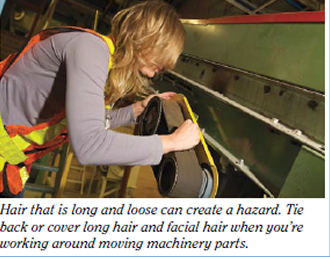
I read a tragic and disturbing story about the danger of getting long hair caught in machinery. A 25-year-old Ohio worker was “scalped” on her sixth night at a new job in an auto parts company, according to this story in Ohio.com.
“Her long brown hair, which hung to midback but was always pulled back for work, became tangled in the machine,” reads the story, which reports the incident is under investigation by OSHA.
The machine ripped her scalp from “just above her eyebrows backward toward her neck,” and she called for coworkers to stop the machine. She was released from the machine by paramedics and 75 percent of her scalp was re-attached in emergency.
Soon after I heard about the young Ohio worker, I saw a new safety alert for the manufacturing industry from WorkSafeBC – The Hazards of Loose Clothing, Gloves, Long Hair, and Jewellery.
“Whether you’re making food products, furniture, sheet metal, or anything else, if you work in the manufacturing industry you will be exposed to the hazards of machinery or equipment with moving parts. Loose clothing, gloves, jewellery, and long hair can get caught in moving parts and cause serious injury or death,” reads the alert.
“In the five years between January 1, 2006, and December 31, 2010, 350 workers [in BC] were injured when their clothing, gloves, jewellery, or hair was caught by moving equipment or machinery parts. Fifty-six of these workers received fractures and another 67 of them had to have their fingers or limbs amputated.”
Danger of gloves near machinery
A UK factory worker lost his fingertip to the first knuckle when his glove was entangled in a drill bit. The news release quotes HSE inspector Hugh Emment, who said: “As this incident illustrates, the wearing of gloves is often a significant factor as it greatly increases the risk of entanglement and serious injuries.”
The HSE story also reports the 21-year-old worker “…had not received any information, instructions or training on using the drill and that it had been unguarded at the time of the incident. Also the operation of the drill had not been risk assessed and there was no formal system in place for checking the drill guard.”
Young workers
Both the workers I’ve mentioned – whose recovery I wish the very best for – were young workers (15 to 24). This age group is injured more often than any other and many online resources for them exist, including the following:
How does sunscreen work?
July 26, 2012
I expect you’ve already heard much about the importance of using sunscreen at work and play – but do you know how different types of sunscreens work? I found a video that explains it well, in less than three minutes, from the US Food and Drug Administration. The FDA implemented new rules for labelling sunscreen, effective June 18, 2012, and this video helps consumers understand their options. FDA Shines Light on Sunscreen explains the new law.
In Canada, it’s Health Canada that “regulates the safety, effectiveness, and quality of sunscreens in Canada,” reads their website.
According to Health Canada, here’s what you can do to protect yourself from the sun:
- Use a broad spectrum sunscreen with an SPF of at least 15, ideally one that is water resistant, and be sure to follow the instructions on the product label.
- If possible, avoid being in the sun between 11:00 a.m. and 4:00 p.m.
- Look for shade, stay under a tree, or use an umbrella.
- During outdoor activities, wear sunglasses to protect your eyes. When the UV index is three or higher, you should also wear protective clothing and a large-brimmed hat.
- Remember to apply sunscreen to all exposed areas of your skin.
The Canadian Dermatology Association Outdoor Workers Program offers posters and other sun safety information for workers and employers.
Ladder safety transcends all industries
July 24, 2012

From WorkSafeBC’s Ladder Safety: Employers Responsibilities and HSE
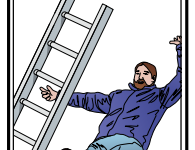
In BC, a hospitality worker died after falling 17 feet from a ladder while checking a smoke detector at the top of a vaulted ceiling in a loft apartment.
I read about this tragedy in the Incident Summary section of a new Ladder Safety Portal from WorkSafeBC. It also includes the story of a retail worker who lost consciousness after falling six feet onto a concrete floor from a stepladder while painting a wall, along with many more descriptions of ladder incidents at different types of workplaces.
“It’s sorted very specifically to ladders,” says WSBC’s Brenda Matsalla, senior regional officer of Emerging Issues – Prevention, who led the Ladder Portal project. “It does touch all industries because we see that it’s a ubiquitous piece of equipment that is used in all industries.”
Levels of responsibility
Employers, supervisors, and workers all have different roles to play. The new portal includes a separate publication for each in its Ladder Safety Series – one-page safety sheets available for free download.
I asked Brenda how she would describe the difference between the three roles.
“The employer is ultimately responsible for health and safety under the Workers Compensation Act. Also under the Act are supervisor and worker responsibilities. They all need to do their part to make sure a ladder is used safely so no one falls,” Brenda says. “For example, employers are required to provide training to all workers on how to properly climb and work from a ladder, supervisors must pay attention to how workers are using ladders, and workers are expected to follow safe ladder practices.”
It’s worth noting that some of the illustrations on the new ladder series are from the UK’s Health and Safety Executive – some of the many resources they offer for free. I read the HSE Update regularly, and here’s a link to one of their ladder safety publications: Ladders – prechecks – things to look for.
Spreading the word on farm safety
July 19, 2012

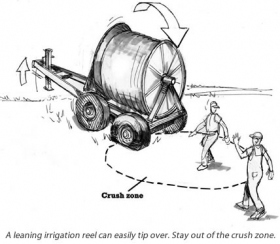
A farmer was changing a flat tire on an irrigation reel when the reel tipped over and crushed him. The reel, which was wound with 400 metres (1,300 feet) of water-filled hose, weighed about 8 tonnes (18,000 pounds). Tragically, the farmer died of his injuries, according to the latest Fatality Alert from WorkSafeBC.
Tragedies like this are all too common on farms, where kids’ safety is also an issue. Each year, on average, 13 kids are killed on Canada’s farms – and that’s why the Canadian Agriculture Safety Association is reaching out to communities throughout the country. One of their biggest initiatives – in addition to Agriculture Safety Week – is Progressive Agriculture Safety Day® events in 2013.
More than 13,500 kids and participants will take part in the activities organized by safety groups in Canada’s rural communities, including several 4H clubs. They look at local safety issues such as sun safety, chemical exposure, and handling animals. I spoke with CASA’s executive director, Marcel Hacault, and asked him to tell me more about the benefits of getting kids involved.
“We are trying to change the culture of farming, and one of the ways we do that is by targeting the pre-culture change. In most rural communities there are at least a couple of kids who are from a farm, or end up being farmers or working for farmers in the future,” he said, via phone from Winnipeg.
“The benefit we see is that it’s been shown to change behaviour in kids and also the volunteers. For every safety day, there’s about one in 10 adult volunteers who attend who are also learning about safety messaging and how to behave safely.”
Marcel said people who are interested in hosting a safety day in their own communities can visit the CASA website to find out more. Congrats to him – and everyone else involved – for generating so much interest in this important issue.
Dealing with workers’ substance abuse
July 17, 2012

From the video "A Deadly Silence: Substance Abuse and Accidents"
I asked a former construction supervisor what he did when workers showed up drunk, hungover, or on drugs.
“As a lead hand, I used to send workers home in the morning if I thought they were still impaired, or smelled too fresh. I would just tell them: ‘I think maybe it was a mistake to come in today, you should have phoned in sick, and I am sending you home,’” he said.
“I wouldn’t report alcohol or drug problems because that would lead to a drug test, and then an indefinite suspension until a doctor cleared them to return to work. It was discreet, efficient. No blaming. Of course, this happened to some more than others, and they were almost always the first laid off when the crew was downsized at the end of the job.”
But discreetly sending someone home really isn’t enough, even though the supervisor felt he was acting with compassion and perhaps adhering to the “don’t rat people out” code. As he said, it happened to some more than others – and there’s a good chance the repeat offenders will create a serious safety hazard before anyone notices their state of mind.
Online course for supervisors
A supervisor in his postion would benefit from this online course for employers Supervising the Drug-free Workplace – from the BC Council on Substance Abuse.
This “practical guide” offers employers an opportunity “to increase their awareness and understanding of substance abuse; help them identify performance problems caused by substance abuse; learn how to discuss problems with employees; and most important, teach supervisors/leaders how to gain an employee’s commitment to correct the problem,” reads the course info sheet.
It takes four hours in total – delivered in two sessions, two hours each, scheduled at specific times. In the meantime, check out A Deadly Silence: Substance Abuse and Accidents – a video that tells the story of four workers whose personal and work lives were affected.
The video – sponsored in 2007 by MacMillan Bloedel, IWA Canada, and WorkSafeBC – discusses the issue of “ratting people out” and the fact that many adhere to a code of silence when their coworkers come to work in an altered state. Some don’t want to risk the job of someone who’s supporting a family – but the video’s main message is that people who abuse substances at work need help – and everyone around them needs to be protected from their unsafe work practices.
Twitter like CB radio for truckers?
July 12, 2012
Some says it’s the similarity to CB radio that makes Twitter popular among truckers.
I’ve heard this from a few of the trucking folks online – including, for example, the TruckerToTrucker blog.
“The social networking site, with its mini-blog format, is the perfect online medium for truckers. Twitter lends itself equally well to long periods of inactivity or short breaks,” reads this post that lists top truckers to follow on Twitter.
Consider the similarities. Both Twitter and CB radio use brief, to-the-point comments and allow people to connect from remote places. You communicate with people you don’t know and form remote relationships – via radio or the Internet – with people you’ve never met in real life.
Both use their own abbreviations that might not make sense to others who don’t use these forms of communication. But for truckers – and others who spend a lot of time alone – these abbreviations and short updates keep them connected with others, for work, idea exchange, and company during long hours of solitude. I picture the truckers I follow – parked at rest stops, catching up on tweets, and sharing their opinions.
Truck and transport folks in BC
I asked John McMahon, executive director of the Trucking Safety Council of BC, if he knew how many truckers in our province are on Twitter – but it’s hard to get hard and fast stats at this point in time. There’s no central place to monitor this sort of information, and people find their own connections on Twitter in many different ways.
John described how the TSCBC continues its efforts to connect with truck and transport folks.
“We are using social media to reach out to our community and establish a relationship with them to help support them in their health and safety interests,” he said, via email. “By doing so, we (TSCBC) hope to engage more and more trucking companies and drivers in initiatives, programs and awareness campaigns that will ultimately improve their health and safety and that of others connected with the industry.”
What’s your Twitter handle?
You can follow me on Twitter, where I’m @SpeakinofSafety – and, if I’m not following you yet, please leave your Twitter handle in the Comments below.
2012 Student Video Contest winners
July 10, 2012

From New Canadian Workers: New Home in One Piece by students at Sir Charles Tupper Secondary
Home in one piece: What motivates you, your friends, or your family to come home safely from work?
That was the 2012 theme for the seventh annual WorkSafeBC Student Video Contest – which generated 66 YouTube entries, representing the work of 195 students from 135 schools.
A number of safety organizations sponsored the project and took part in the judging process – using criteria from WorkSafeBC – including ACTSafe, the organization that promotes health and safety in the performing arts and motion picture industries. I spoke with Dawn Brennan, ACTSafe’s general manager, about her experience as a judge.
“It was such an amazing gamut of videos,” Dawn said, describing how she and her staff met and watched them together. ” I love the fact that high school kids took this seriously. The messages were all so varied but interesting, and it was such emotional impact they made. A couple had me in tears.”
Dawn said she enjoyed talking with the creators about their work, when she met them at an awards ceremony. One was very interested in film-making as a career, and Dawn says she is going to distribute the students’ videos to her network of industry contacts.
Congratulations to all winners – see winning vids here – and thanks for doing your part to share an important message.
Reaching young BC workers on Facebook
July 05, 2012

It is estimated that one million BC youth between the ages of 17 and 25 have Facebook accounts. On average, each Facebook user has 190 Facebook friends.
“As such, targeting prevention messages through Facebook and engaging the viral aspects of social media presents an opportunity to extend injury prevention awareness to a large audience of youth,” says Trudi Rondeau, WorkSafeBC’s Young and New Worker manager.
Trudi and her team are inviting BC residents 13 and older to visit the new Dangerously Exposed Facebook page, where they can play a new game and enter to win an iPad.
“The game focuses on exposure hazards that present the greatest risk to youth – noise, chemicals and airborne particles like asbestos and silica dust,” Trudi says. “The message is serious, but game play is fun. And we’re really hoping the viral element of Facebook helps build a big community of players.”
Players “Like” the game on Facebook and see how their score compares among their Facebook friends who play. In it, participants look at pairs of photos to identify which worker is more dangerously exposed to a hazard. At the end, a results page shows how they’ve scored and describes how to avoid the exposures shown.
Players can also submit a story explaining how they work to make their own workplace safer, then have a Facebook friend verify the story. WorkSafeBC will judge the stories and award a new iPad to both the player and the verifier.
Some of the stories will be shared on the Dangerously Exposed Facebook page – such as this one from Sydney DiBenedetto, winner of WorkSafeBC’s Student Safety Video Contest, who reminded her friend to use the safety guard on a table saw in shop class.
Asking road users what they need
July 03, 2012

BC HighwayCams: "Know before you go"
“Where would you like to see a BC HighwayCam in our province to better help you know before you go?”
It’s an important question indeed – for working drivers and the public – and throughout June it was TranBC‘s monthly survey question. These cameras contribute to the safety of all road users who can go online, see road conditions, and plan their routes.
TranBC is an online education, awareness, and engagement initiative of the BC Ministry of Transportation and Infrastructure. It was on Twitter that I first saw a link to their HighwayCam survey – and I wondered how many participated.
I asked Russel Lolacher, director of social media for the BC Ministry of Transportation and Infrastructure’s Business Management Services. He said (on June 21) they had received more than 500. (Update: “FYI, we ended up with over 700 responses to the web cam survey. Great feedback as to where people want new cams,” said @TranBC via Twitter on July 3).
“BC highway webcams are one of our most popular online services here at the Ministry of Transportation, and to better serve the public, we want to engage those that use them,” Russel said, via email. “We would like to hear from professional drivers due to their experience, travelling our transportation consistently. Their knowledge is invaluable, as is their input.”
Starting conversations and building relationships
TranBC is using many platforms to connect with their stakeholders – i.e., this survey, along with Facebook, Twitter, YouTube, and more (see below). I asked Russel if he had any advice for organizations who want to use this social media technology to get input from their own stakeholders.
“The best piece of advice I would recommend is not to look at it as using technology, but rather as hearing from people. The social platforms you’ve just mentioned are just tools, it’s the human engagement that matters most regardless of the medium you use,” Russel said.
“To be successful in hearing from your stakeholders, an organization has to look at it as an ongoing conversation and relationship building, rather than ‘one-offs.’ Through our social channels such as TranBC and DriveBC, we are working to build a long-term presence as the online BC Transportation resource for the travelling public.”
Each month, TranBC is launching a different survey. In July, the public is invited to share their views on how Transportation and Infrastructure can improve its level of customer service.
You can find TranBC on Twitter, Facebook, Flickr, Youtube, Foursquare, and – most recently – Pinterest.