Archive for January, 2012
Customizable form streamlines return to work
January 31, 2012
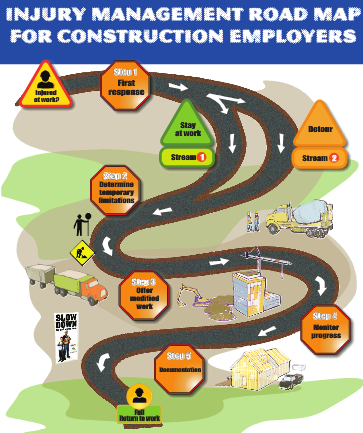
Here’s a new online resource for simplifying the early return-to-work process for injured workers – originally made for construction but generic enough for employers in any industry.

The Injury Management Road Map was created by a team led by Judy Reilly, client services manager for WorkSafeBC’s Construction & Return-To-Work Services department. I gave her a call to see what employers can get from the new step-by-step guide for employers to follow when a workplace injury occurs.
Judy said the Road Map will help employers deal with the detours and unnecessary bumps in the road, and ensure that the RTW process is managed efficiently and effectively, allowing injured employees to remain at work or return to productive and appropriate work as soon as possible.
The online guide is most useful for small to medium employers who – unlike large employers – don’t have human resources staff on-site to manage RTW programs.
Having all paperwork ready
One useful form, for example, is the Stay-at-work/return-to-work planning form, which provides a typical list of limitations as a starting point for developing a custom return-to-work or modified duties plan. For example, the doctor could select “Limit long periods of walking or standing” or “Avoid jarring” as appropriate. The form can also be downloaded and customized with your own logo, etc.
Judy talked about this problem in the Nov/Dec 2010 issue of WorkSafe Magazine. She said there’s 20 years of research that show it’s “misguided” for injured workers to stay home and rest until fully recovered.
“In general, our physical fitness can start to decline after one week of inactivity,” she told WSM. “So the longer an employee is off work, the longer it takes to get back to full capacity; and the less likely he or she is to return to the job.”
She said an injured worker can transition back into the workplace earlier and more safely when the employer takes immediate steps to accommodate the worker’s injury. Having the right paperwork on hand, when needed, can speed the RTW process, which benefits all.
“The employer can give the RTW package to workers, and tell them: ‘Talk to your doctor about modified duties and bring this back.’ It’s a proactive way that helps the worker and it’s even an education to the physician as they’re going through it,” Judy said. “From the employer’s perspective, they don’t have to create it themselves. It’s all there for them.”
Your experiences with RTW
What kinds of duties do you keep available for modified duties? Have you ever worked on modified duties yourself? Please share your story in the Comments below.
Kudos to bus drivers in the snow
January 26, 2012
When the snow falls in Vancouver – as it has this January – the transit drivers have their work cut out for them.
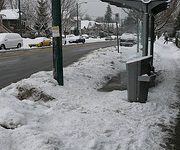
They navigate challenging roads, where vehicles slide at odd angles, despite the City‘s good work clearing the streets. More passengers than usual line up at snow-lined bus stops, tracking mush into the aisles, taking extra time to get their fares out as they struggle with mitts and gloves.
One driver described an aspect of his job I hadn’t thought about. He wrote on Facebook: “I’m off to work. Tonite will be one of those nights where I got dozens of people just looking for a warm place to thaw out for a few minutes. I am glad I can help.”
Efforts from drivers like this are not going unnoticed. One passenger reported, via Facebook: “I found the bus drivers jovial and helpful – as always – but extra nice when it’s actually kinda stressful to drive in these conditions.”
@Translink on Twitter
Stressful indeed! Translink – employer of the bus drivers – posts regularly on Twitter, so I checked out their tweets to see if I could find out what it’s like for the hard-working bus drivers of Metro Vancouver. But mostly @Translink was updating passengers on things like “Skytrain is experiencing delays of approx 15 minutes due to a mechanical issue, Sorry for the delay.”
I posted on Twitter, via @SpeakingofSafety: “I’m writing a blog post thanking bus drivers in the snow. It looks stressful to drive, but they seem very skilled. Kudos!”
The Translink employee writing on behalf of his organization responded: “Thank you for taking time out of your day to do that; they do work very hard especially on days like this.” Then he (or she) got back to the busy job of responding to individual’s complaints about their travels – like this one, in response to someone who tweeted “screw Translink” and said they’d been waiting 20 minutes: “Sorry you are waiting in the cold, where are you I can check for the closest 41?” came the reply.
Bus driver safety
I’m going to follow up on this with a story on bus driver safety. How do they prepare for driving in these conditions? How do they prepare for and deal with other safety issues, like violence?
If you’re a bus driver and you have a story to share about how you stay safe at work, please email me at susan@speakingofsafety.ca.
Setting the stage for a warehouse injury
January 24, 2012
Why did this young worker – with less than three weeks on the job – fall 13 feet from a forklift onto a cement floor?
A new audio slideshow from WorkSafeBC explains what went wrong, including best practices for prevention. It reminds me of the union rep who visited young workers to talk about workplace safety and refusing unsafe work. I shared her story in which she said: “Some of them were kids who had never had jobs, and they were already saying: ‘Ya but if I start refusing work, he’s just going to get someone else to do it.’”
This attitude has to change, so let’s do all we can to support young workers – whether they’re your staff or your own kids. Links to resources are below the slideshow.
More info on young worker safety
The RaiseYourHand website, created for young workers, aims to “empower you and all young workers in BC to use the rights that will keep you safe on the job.”
The WorkSafeBC Young Worker portal – for workers, employers, unions, educators, parents, and youth community groups
The Young Workers Zone – from the Canadian Centre for Occupational Health and Safety
Sharing farm safety knowledge
January 17, 2012

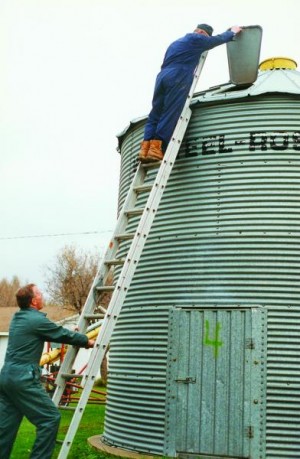
Photo courtesy of the MB Labour & Immigration - Workplace Safety & Health Div. (via the CASA website)
Canadian Agriculture Safety Week is March 11 to 17, 2012 – and plans are underway for its launch in BC.
I talked with Diane Wreford of the Canadian Agricultural Safety Association, who told me what planners have in mind for the BC launch. It sounds really cool – and I’m hoping to go – but I won’t tell you til it’s finalized. Past launches have taken place in nurseries, fields, and potato processing plants in different provinces – and now it’s BC’s turn for the spotlight.
“We try to emphasize that whatever you do, safety should be first,” Diane said, describing how CASA and its partners are creating their safety resources based on requests from farmers who responded to an online survey from Farm Credit Canada.
It reports 85 percent of Canadian producers understand the importance of farm safety and 34 percent want training in the basics of preparing a safety plan for their operations. Now that plan is available for download on the CASA website.
“They all say safety is really important, but in fact only one in 10 has a plan,” Diane said. “And we’re saying: ‘Okay, you can’t really be serious unless you’ve committed yourself publicly – unless you’ve got a real plan.”
Sharing resources
Diane said CASA shares lots of agriculture safety resources from BC and Ontario.
“They’re the two provinces that have very well-supported farm safety groups and they have the expertise and financial support to come up with great resources,” said Diane, adding that CASA also shares resources created by funding from the federal government – Agriculture and Agri-food Canada.
New agriculture safety resources will be on the CASA website soon – so check it out – and stay tuned for news on the BC launch.
What’s wrong with this photo? (Arborist safety)
January 12, 2012
The current issue of WorkSafe Magazine features a landscaping scenario in its popular photo challenge, “What’s Wrong With This Photo?”
The staged photo includes at least six hazardous work habits (possibly many more), and your challenge is to identify them and submit your answers to WorkSafe Magazine by January 30, 2012. Your response may be printed in the next bimonthly issue and your name will be put into a draw for a small prize. You can even play online.

Speaking of arborists, I saw an unusual tree incident recently in my neighbourhood. The tree was deemed dangerous because a water pipe had broken beneath its roots, creating potential for it to topple.

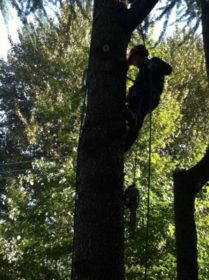
Arborist falls tree that needs emergency removal because a major water pipe broke under its roots, S.Main photo
Arborists showed up and climbed the 60-foot tree in beside a townhouse complex and a busy street, with lots of electrical wires above. School children and passers-by stood outside the cordoned-off safety area and watched one of them climb the tree and slice off its branches with a small saw held in the air by ropes.
The worker wore fall protection, eye protection, and other PPE described in the WorkSafeBC publication Safe Work Practices for Certified Utility Arborists: Tree-care work near power lines (PDF 6mb).
What I saw that day looked like a safe operation, unlike the dangerous situation staged in “What’s Wrong With This Photo?” – which you can visit online and try now.
Good luck!
BCIT wins NAOSH award 5 years in a row
January 10, 2012
I’ve been following up with NAOSH (North American Occupational Safety and Health) Week 2011 winners and contacted TJ Garcha, health & safety coordinator for the BC Institute of Technology. He told me about BCIT’s NAOSH Week entry that won them the Educational Institutions category for the fifth year in a row.
In 2011, BCIT turned the NAOSH Week challenge into a WHMIS (Workplace Hazardous Materials Information System) challenge. WHMIS training is mandatory for all BCIT employees, so one of the organization’s goals was to increase staff participation in WHMIS training. To be eligible for a prize, BCIT employees had to complete their WHMIS training and then enter their name into the prize pool before the end of NAOSH Week.
This year the prize pool was bigger than ever, with 35 prizes and lots of giveaways from health and safety exhibitors. “Any time there are prizes or incentives involved, the interest level of participants goes up,” said TJ.

Other activities included “lunch and learn” sessions – on topics like “Major Events and Radiation Contamination” and the general NAOSH theme: “Prepared? What’s Your Plan?” – along with online quizzes (one for each of the five NAOSH week days) and a popular kids’ colouring contest.
“Everyone at BCIT was reminded that the more entries they got in, the better chances they had in winning a prize,” TJ said, describing “meal vouchers for use at BCIT eateries, custom hearing protection, high quality ear muffs, and a variety of gift cards from Starbucks, Toys-R-Us and Future Shop.”
Marketing NAOSH Week activities on campus
According to TJ, the campus atmosphere really lends itself to NAOSH participation.
“With a large number of students and employees on campus, advertising and marketing is quite effective and this generates interest for our many events throughout the year,” he said. “Also, with the Exhibition, we didn’t need to invite the community – the event was brought to the community. This approach helps maximize participation.”
BCIT’s health & safety exhibition during NAOSH Week included Acklands Grainger; Alda Pharmaceuticals; ER Plus; Community Fire Prevention Ltd.; F.A.S.T.; Sperian; Mediquest; Custom Protect Ear; WorkSafeBC; Wasserman Partners; Evolution Radio 107.9 FM; BCIT Safety, Security & Emergency Management; BCIT Human Resources; BCIT Audiometric Office; BCIT Recreation Services.
“Overall, NAOSH Week is an opportunity to raise awareness about Health & Safety issues to the community through a variety of different mediums. The awareness benefits everyone,” TJ said. “While organizing these fun and interactive activities, we (the organizers) learn a lot ourselves. The experience is very rewarding.”
Congratulations to BCIT and thanks to TJ for telling me his story. Visit the 2012 NAOSH Week website for more info.
Musician reconsiders hearing protection
January 05, 2012
In a recent post I talked with a singer about the importance of hearing protection. Shortly after, I talked to a different musician who said: “I can’t wear earplugs when playing music. I’ve tried, but I find it disorienting and detaching – not allowing me to hear what’s really happening.”
Jim (not his real name) is 45 and has played guitar in jazz and rock bands for 20+ years. He’s not the only musician who dislikes conventional earplugs. His sentiment is echoed in A Review of Orchestral Musicians’ Hearing Loss Risks from WorkSafeBC’s Hearing Conservation Section, which describes how “conventional hearing protectors are often unsuitable for musicians.”
Conventional earplugs “attenuate high frequencies more than lows, resulting in distortion of the music. The occlusion effect (an enhancement of low-frequency, bone-conducted sound due to plugging the ear canal) causes an ‘echoey’ perception of sound unacceptable to musicians,” reads the review.
Earplugs for musicians
Fortunately for Jim, there’s another option that can prevent hearing loss before it’s too late. Custom earplugs – made by a US company called Etymotic Research Inc. – are an industry standard, described in this info-sheet from WorkSafeBC.
“Luckily I haven’t (yet!) experienced any noticeable deterioration in my hearing,” Jim said. “However, most veteran musicians I work with wear earplugs when they perform. The more serious among them wear the ‘good’ ones – considerably more expensive than the $1 sponge cylinders now offered in most clubs – and they are custom made by an aural specialist to fit the user’s ears and to attenuate user-specific frequency ranges. I’ve been told they’re really effective and can make a cacophonous stage sound serene.”
These Musician’s Earplugs “reduce sound levels evenly so that music and speech are clear and natural, not muffled as with other earplugs,” reads the ER website.
“Perhaps I should reconsider it before I end up like a drummer I know, who after 30+ years of playing drums, started noticing his hearing was deteriorating,” Jim said.
For around $200, the earplugs sound like a good investment, and here’s more info that might convince him and others who depend on their hearing.
Listen While You Work: Hearing Conservation for the Arts – from Actsafe (formerly SHAPE, Safety and Health in Arts Production and Entertainment)
Musicians & the Prevention of Hearing Loss
From the Musician’s Clinic of Canada
Resolve to stretch to reduce MSIs
January 03, 2012
It’s the new year and many people are heading into 2012 resolved to end bad habits or start good ones.
If you’re looking for a great new habit for the workplace, check out Workplace Warm-up and Stretches from the FIOSA-MIOSA Safety Alliance.
It describes how pre-shift stretching can reduce the risk of musculoskeletal injuries (MSIs) by
* Increasing blood flow to muscle tissue
* Reducing muscle tension
* Developing body awareness
* Increasing ability to focus
Considering that back strain accounts for nearly 25 percent of all WorkSafeBC claims, I’d say this kind of simple stretching program is well worth the time and effort it takes to get workers (or your employer) interested.
The Safety Alliance info sheet reminds employers that “it is important to consult with employees as they often have excellent ideas for improvement. By developing the program collaboratively with workers, workers are more likely to accept other changes such as job rotation or proper lifting techniques.”
Your good intentions for 2012?
Do you have any resolutions you’d like to share? Tell me by commenting below, and I will check back and encourage you. If you’re already participating in a workplace stretching program, I’d love to hear how it’s going.