

Archive for December, 2011
Year-end wrap up for 2011
December 22, 2011
This is my last post for the year. I’m taking a break for the holidays, and will be posting again in 2012.
Please let me know if there are any topics you’d like me to explore in the new year.
I’m always looking for new stories to share, so please email me at susan@speakingofsafety.ca.
Top 5 posts of 2011
Here’s a quick redux of the Top 5 most-viewed posts of 2011.
It seems funny to read this right now, in chilly December – but it was the most-read post of 2011. (These days, you’re better off reviewing Hypothermia: Surviving the Cold from WorkSafeBC.)
This post had thousands of visitors when it was published in December 2010 and people kept reading it well into 2011. It’s hard work for Santa to supervise all those energetic elves.
This story came from a friend who told me how she called her supervisor to stop two coworkers at risk of getting electrocuted while vacuuming a rental car.
Trick-or-treaters get lesson in PPE
This post shows how the construction worker costume is a fun and visual costume for kids that introduces the importance of personal protective equipment.
RCMP adds Cold Fire to arsenal
This post describes a biodegradable fire extinguishing agent that “take the heat out of fire” and is used by the RCMP’s emergency response team.
Happy New Year
Thanks for reading – and all the best in 2012.
Trying to get warm when you live outside
December 20, 2011
This post is a bit of a departure from my usual topic of workplace safety – but it’s something to think about during this season of charity when many people make donations through work.
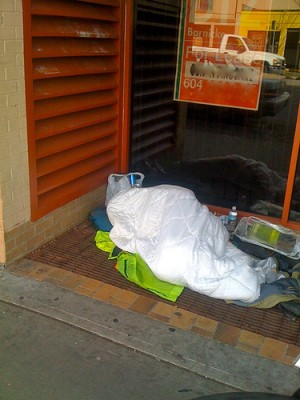
Today I talked to a man who lives in a tent, deep in the bushes above a railway track in East Vancouver. He uses an old hibachi to heat up discarded food from restaurants and the garbage – mainly eating the protein and sprinkling bread crumbs around for any rats, mice, or raccoons that might stop by.
Heating his tent with burnt newspapers
You know those free newspapers people give out at the Skytrain? He takes them, does the crossword, then rolls them up “like a presto log” – which he demonstrated. He puts the paper into his hibachi, lights it on fire, puts it by the entrance of his tent, and opens his tent so the heat of the fire will “warm up the inside.” This puts him at risk of carbon monoxide poisoning or smoke inhalation, which has killed others in similar situations, and he’s also vulnerable to hypothermia.
When I asked him how he vented the smoke safely, he laughed and said: “Oh my tent has lots of holes!”
Recently he mentioned his battle with bedbugs and mice in his hotel room, and when I saw him today, I asked what had happened. He said the hotel did nothing, so he threw out the mattress, went to the welfare office, and left with a cheque for $50 to get a new bed. Then the welfare agent sent the hotel a bill to recoup the $50, and in response, Ben said, the hotel owners got angry and kicked him out – so now he’s living in the tent.
At the end of our chat, he walked away with his cart, and I went back into my warm house. But I keep thinking about him and the many other people in Vancouver without homes this winter.
2011 Homeless Report
The 2011 Homeless Count is a “24-hour snapshot of homelessness” taken in Metro Vancouver on March 16, 2011 – with a final count and report issued by the Greater Vancouver Regional Steering Committee on Homelessness (RSCH) and the Aboriginal Homelessness Steering Committee (AHSC).
A total of 2,623 people were found to be homeless, says the preliminary report, including “‘unsheltered homeless’ or people who were found outside on the street, in parks, at drop-in programs and ‘sheltered homeless’ or those who spent the night in shelters, safe houses, transition houses, hospitals, jails, remand centres, and detox and recovery facilities.”
How can we help?
Cash, food, blankets, coats, toiletries, and many other things are needed at the shelters – so check out these organizations and please consider donating to their programs.
Volunteers drive party guests home
December 15, 2011
‘Tis the season for parties at work and nights out with friends. It’s also the December CounterAttack campaign against impaired driving, launched each year by the province of BC, police, and the Insurance Corporation of BC.
I received a press release from the BCAA Road Safety Foundation that reported the number of deaths and serious injuries caused by impaired drivers in BC is down by almost half in the past year.
We still have a long way to go – but it’s important to acknowledge success along the way – and one group that has surely helped to bring down these tragic numbers is Operation Red Nose and its volunteers who drive motorists home in their own cars during the holiday season.
The program started in Quebec City in 1984 and in recent years an average of 55,000 volunteers across the country give 80,000 rides home from Nov. 25 to Dec. 31, 9 p.m. to 3 a.m. In BC, during the weekend of Nov. 25 to 27, 1,374 motorists made a “smart choice of a safe ride home,” says this press release from Operation Red Nose, sponsored in BC by ICBC and CTV.
This year in Canada, there are 111 Canadian communities taking part. It’s also available for people who don’t feel fit to drive because of other reasons like fatigue or medication.
“The mission of Operation Red Nose is to encourage responsible behavior (in a non-judgmental manner) with regard to impaired driving by enabling communities to provide a free and confidential chauffeur service to their members, the financial benefits of which are redistributed to local organizations dedicated to youth,” reads their web site.
To see if this is an option in your region, check out the operation Red Nose website or call 1-877-604-NOSE. Employers can visit the Operation Red Nose website to get information on arranging rides for staff parties. The service is free, and drivers are asked for donations that go to amateur sports programs.
Kudos to volunteers
It’s so touching to think about these volunteers – out late at night in the cold – making sure people get home safely. No doubt, their caring actions have saved a lot of lives.
Seven tips for safer winter driving
December 13, 2011
“Do you really need to go?”
That’s the first question to ask ourselves before we drive in harsh winter weather, according to the folks behind the Shift Into Winter campaign.
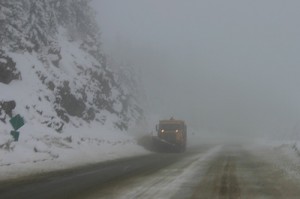
If you really do need to drive, for work or other reasons, here are seven steps to safety, taken from WorkSafeBC’s Prepare Yourself for Winter Driving:
- Check the current road conditions and weather forecast. Listen to the radio, TV and visit DriveBC.ca.
- Plan your route ahead of time.
- Leave lots of time so you’re not rushing to get to where you need to be and try to travel during daylight.
- Learn winter road skills.
- Keep at least four seconds distance between you and the vehicle in front of you.
- Wear comfortable clothing that doesn’t restrict your movement while driving.
- Have an emergency plan. If you get stuck or stranded, don’t panic. Stay with your vehicle for safety and warmth. If you have a cell phone and it is an emergency, call 911.
Shift Into Winter
Joanna Wyatt, project leader for the Winter Driving Safety Alliance, emailed to suggest I write a blog post about winter driving safety – so here it is. I wrote about this topic last year in my post Help for the snowphobic. I described my personal safety tactic for winter roads – i.e. not driving on them -and this is what I will do again this year. I’ll walk or take transit if I have to go out in the snow.
How do you feel about driving in the snow? Have any tips to share? Seen any stranded drivers lately? Tell us about it in the Comments box.
Raise Your Hand winner inspires peers
December 08, 2011
“As a supervisor, I do inspections and take feedback from workers to deal with safety issues immediately.”
That’s what aquatics supervisor Chris Cordova wrote in his winning entry to the Raise Your Hand challenge. He had 25 words or less to answer the question “How do you raise your hand for safety at work?” and his answer won him an Xbox game package in this contest I told you about in July.
I emailed Chris to say congrats and ask him about his work – and here’s what he wrote back:
“Working with a lot of young workers, we try to prevent injuries from happening through regular inservice training. This includes how to use safety equipment… [and] we have made daily checklists for the staff to complete such as checking the diving boards to make sure they are secure and making sure none of the overnight staff left chemicals on the pool deck.
“We have regular facility inspections and… things we look for are items such as loose tiles that people could trip on, areas of the pool deck that have lost grip and may be more slippery when wet, checking lane ropes for when they become frayed so that staff don’t cut their fingers, I’m also in charge of inspecting the first aid equipment to make sure that our kits are stocked and ready to use.
“Often with my staff being on the pool deck, and the number of patrons who come into the facility, I’ll learn about safety issues from my staff directly, since my office is close to the lifeguard control room. If I’m not in and if the issue is not severe, staff will usually contact the Building Service Worker and I’ll usually have a post-it note on my door telling me of the issue. Depending on the severity of the issue, I’ll make a decision as to the best course of action whether it be closing a section of the facility, or having a staff member deal with the situation at hand (ie: cleaning). I’ll also check on staff and the facility during my work day to make sure there are no safety issues.”
Related resources
I found this info on Aquatic Safety Audits from the B.C. & Yukon Branch of the Lifesaving Society
Recently at the pool, I saw some kids having a fight, and was impressed by the lifeguard’s respectful treatment of all involved. Then I found this Sample Anti-Violence Policy for Recreation Facilities from the Government of BC
Congrats again to Chris – and thanks for sharing the extra details on keeping your workers safe at the pool.
Eye-patch basketball sends safety message
December 06, 2011
A group of young warehouse workers at Versacold/EV Logistics in Metro Vancouver found an interesting way to get their coworkers thinking about what it’s like to live with an injury.
During NAOSH Week, workers organized games like eye-patch basketball, one-armed slap-shot, and one-legged golf putting – and this is one of the reasons they were chosen as best overall winner in BC’s NAOSH Week competition for 2011.
Mike Stephens, occupational health and safety manager for the Versacold’s Western Canada region, said planning for safety week begins by asking for volunteers – known as “Safety Week Champions” – to be the lead organizers for events at their facility.
“They found a way to reach out to the employees so they get the message, and they also have fun doing it,” Mike said. “At the EV Logistics locations, the workforce is largely made up of young males. One of the things of interest to young males is sports – like basketball and hockey.”
Other activities held throughout the region included a partnership with the Canadian Blood Service to hold a blood drive clinic, multiple in-house forklift rally competitions, evacuation drills, health and fitness seminars, and more.
“We have participated in NAOSH week in the region since 2006. It is a great opportunity to focus on safety initiatives, have some fun and take some time to reflect on the importance of working safe every day in our jobs,” Mike said, describing what he likes about NAOSH Week.
“It’s good to see people get really enthused about safety. The safety champions at each facility are great at developing new innovative and creative ideas to promote safety during NAOSH Week. The really rewarding part is the cultural change in our employees and overall improvements to safety in our organization.”
Mike accepted the award on behalf of Versacold, but he gave credit to the many others who made NAOSH Week a success.
“I’ve got to hand it to the people at our facilities – the managers, the champions that sponsored and put on these events. They’re the ones who really deserve the recognition. They’re the ones who put the time and effort in. I’m just the overall organizer.”
Thanks to Mike and congrats to Versacold/EV Logistics.
Resources to prevent violence at work
December 01, 2011
I read an article in the November/December 2011 issue of WorkSafe Magazine about a new online tool for preventing workplace violence.
Employers sign up and their workers answer questions online about their specific workplace. The program evaluates each survey and compiles a list of potential violence-related risks.
“Once the risks have been identified, the e-tool brings up articles related to prevention strategies from the knowledge base… culled from hundreds of policy and procedure documents from reputable agencies…” reads the WorkSafeBC article by Gail Johnson.
The online program is the result of joint efforts from the BC Public Service Agency, the BC Government and Service Employers Union, and the University of BC – funded by WorkSafeBC.
A tale of avoiding violence
Health care workers are often faced with aggressive behaviour from clients – many of whom are angry, scared, or frustrated with their situation. According to WorkSafeBC, violence is a leading cause of injury to B.C. care workers and results in more than 1000 injuries each year.
I talked with a community health nurse recently about some of the threats he’s faced from clients he visits in shelters and hotels in Vancouver’s Downtown Eastside. He said violence is threatened, but actual incidents are rare. I followed up with a contact at WorkSafeBC who confirmed there was no significant number of violence-related claims among community health nurses.
Once the nurse went to a hotel to see a man with a suspected leg infection. He introduced himself and asked if he could have a look.
“I thought I heard him say ‘yeah’ or shake his head, but apparently he’s partially deaf and he hadn’t heard me at all,” he said.
“I went down to lift up his pant leg, and he turned at me and raised his hand as if to hit me, and so of course I backed out of that situation and explained that I was a nurse – there to look at his wounds. He told me he did not want me to look at his wounds and so I left.”
Thankfully the threat of violence was averted, and a female nurse went back later and treated the man. There are many tactics for cooling the flames, depending on the industry and the situation, and the new online program brings many of them to industry. Kudos to the collaborators!
New violence prevention resources online
WorkSafeBC is offering a new set of online resources for workers and employers, including videos, e-publications, and links to violence-related info in the Regulation.