
Archive for September, 2011
Sharing streets on foot, bike, car
September 28, 2011
Getting to work can be a safety issue in itself – when you think about cyclists, motorists, and pedestrians sharing so much of the same space. The City of Vancouver reports 3,500 workers ride bicycles to jobs in downtown Vancouver each day. That’s a lot of road-sharing! This video shows how they’re dealing with it in Boston.
The power of a tire explosion
September 27, 2011

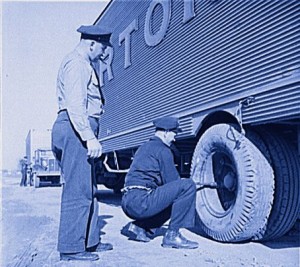
Photo credit: John Vachon, USA, 1943, Library of Congress Prints and Photographs Division Washington, D.C.
Tires can explode with deadly force – for a few different reasons.
Recently I met a former mechanic named Petr at my favourite local coffee shop. He told me about a tire explosion he experienced a few years ago when he was working as a mobile mechanic for his dad’s company, rescuing broken-down trucks from the highways of Ontario and Quebec.
One night he was dispatched to fix a flat on a big truck, when the driver reported that his air brakes had failed earlier. Petr wasn’t sure what the driver was talking about, since it was fairly difficult to re-attach air brakes. He removed the wheel to fix the flat and noticed the brake line was “just hanging back there.”
The driver had gone all the way from Mississauga to Montreal – 538 kilometres – with a locked brake. Not good. Petr told me what happened next.
“I had the flat tire on the tailgate of my truck, inflating, and covered in soap to see where the flat is,” Petr wrote, via email. “I was in the driver’s seat, filling out a work order when my world jumped and I had a face-full of steering wheel. The tire had exploded and somehow threw itself a good six feet next to where the driver had been.”
It turns out the tire had been held in place by the locked brake. The rim of the wheel spun inside it all that time, creating so much heat from friction that it “completely annihilated the metal cords that held the tire together,” Petr explained.
Thankfully no one was hurt – even though the driver was, as Petr put it: “pale as a ghost with a completely empty colon.”
Tire explosions can be deadly
Tires can exploded for a number of reasons. Over-inflating causes explosions, as can under-inflating tires – which leads to damage and irregular wear. Improper fitting onto rims is also dangerous.
These videos show how dangerous tires can be – so please be careful at work and on the road. Thanks again to Petr for telling me about his experience, and if you have a story to share, email susan@speakingofsafety.ca.
Safety for hotel room attendants
September 22, 2011
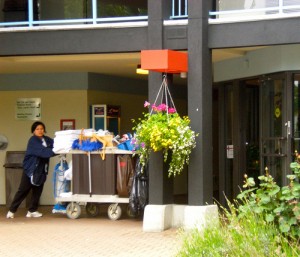
When you’re pushing carts, making beds, lifting, and bending, it’s important to use the best ergonomics possible and take precautions to avoid slips, trips, and falls.
A post on OHS Online looks at this group of workers and outlines a new NIOSH fact sheet on how to improve safety for them.
Most room cleaners are women, many are immigrants, and their injury rate is the highest among hotel workers.
NIOSH advises organizations to “identify and evaluate hazards and adopt interventions to prevent work-related injuries and illnesses in the hotel environment” – and this is exactly what a group of hotel industry reps is doing in BC.
Hotel safety in BC
Trina Wright is the program manager, industry health and safety at go2 – the BC tourism and hospitality industry’s human resource association. go2 is also the industry’s health & safety resource and COR certifying partner.
Trina facilitates an industry health & safety technical advisory committee of general managers, HR and safety professionals from BC hotel properties. The group is working together to identify key accidents for the hotel sector and develop strategies for prevention.
“We will aid the rest of the sector in reducing their injury rate, cost, and duration,” Trina said via email. “One of our key focuses this year is reducing the injury rate and duration for housekeeping staff.”
Michael King is a member of the technical advisory committee. He’s the safety and loss prevention manager for Fairmont Waterfront Hotel in Vancouver, where he and his colleagues have been testing an assistive device for workers who change beds. It’s called BedToolzzz and some Fairmont workers are trained to use it. Michael said they may use it for training and return-to-work programs.
I asked Michael how changing beds can pose an ergonomic hazard.
“In most guest rooms the design aspect takes precedent over the practicality of cleaning a room, which means that rooms are often tightly configured with little space between the bed and the bedside tables,” Michael wrote. “This makes access to the head area and corner of the bed very tricky unless excellent ergonomics are used.”
go2 also has a technical advisory committee looking at workers’ safety on BC’s 40 ski hills – so stay tuned for more.
More info on room cleaner safety
Preventing Injuries to Room Attendants from WorkSafeBC
Hotel Housekeeping – OSH Answers from CCOHS
Grain is like quicksand
September 20, 2011
I read a tragic story recently about two teens who died at work in Illinois while trying to get corn flowing in a grain bin. “The kernels suddenly assumed the nature of quicksand” and the boys were buried in seconds, reads the post in SafetyCommunity.com.
Twenty-five people died in granary accidents in 2010 and five of them were under 16, the post says, quoting Purdue University’s 2010 Summary of Grain Entrapments in the United States. It says there were 51 grain immersion accidents in the US in 2010, up from 38 in 2009.
I followed up with Nicole Hornett, farm safety coordinator with Alberta Agriculture and Rural Development, and learned that she does a grain safety education program for kids and young workers.
“Once a person is completely under the surface of the grain, ‘drowning’ happens quickly, as the grain and grain dust quickly enter the nose and mouth, making it impossible to breathe,” Nicole said, via email. “The further someone is buried into the grain, the harder it is to pull them back out, countering the force, friction and the additional weight of the grain.”

Grain tug-of-war
Nicole does a demo that simulates what happens when someone is buried in grain. She gets a garbage bin and places a plywood disk at the bottom. A rope runs through the middle of the disk and out the top of the bin. She fills the bin with grain and lets people see how hard it is to pull the disk out of the grain.
“The demo shows how quickly someone can be entrapped in grain – and then how much extra force the grain exerts on the body. It’s not a simple matter of just pulling someone back out,” Nicole wrote.
“Even if someone was firmly holding onto a rope when they became entrapped in the grain, the typical force is around four times the person’s body weight. People are not strong enough to pull themselves out, i.e. a 200-pound man would need to be able to lift 800 pounds.”
For more info on working safely around grain, check out:
Dangers of Engulfment and Suffocation in Grain Bins – Hazard Alert from OSHA, released Aug. 11, 2011
Grain handling from OSHA
Suffocation Hazards in Grain Bins from the University of Arkansas
Grain Bin Safety from University of Illinois Extension
Spotlight on mining safety
September 15, 2011

A mine rescue team carries out a simulation during the 2010 Mine Rescue and First Aid Competition in BC.
I read a story in OHS Magazine Online about a mining safety program in the US.
The Brookwood-Sago grant program is named in memory of 25 miners who died at work in Brookwood, Alabama and at the Sago Mine in Buckhannon, West Virginia.
The grant program announced $1 million will be available for eligible mining companies to help them identify, avoid, and prevent unsafe working conditions. It’s run by the U.S. Department of Labor’s Mine Safety and Health Administration (MSHA).
In 2010, there were 48 fatalities in the US mining industry, down from 1978 when 242 miners died and the MSHA started operating. That’s a big improvement with a long way to go – and I’m hopeful the Brookwood-Sago grants will make a difference.
Mining safely in BC
Here in BC, no miners died at work in 2010.
The injury rate for miners is the lowest among BC’s heavy industries, reports the Mining Association of BC on their website.
The BC mining industry is governed by a different set of rules. Most BC employers are subject to the Occupational Health and Safety Regulation, but mining companies are not. Instead, they are expected to comply with the Mines Act and The Health, Safety and Reclamation Code, administered by the BC Ministry of Energy and Mines.
Al Hoffman is the Ministry’s Chief Inspector of Mines/Executive Director of Health & Safety. I asked him, via email, what kind of safety training his ministry offered to BC mining companies. He said they offer “mine rescue and musculoskeletal (ergonomics) training, occupational health and safety committee training, and industrial hygiene.”
But legally, it’s up to the mining companies when it comes to safety training, he says.
“The Health Safety and Reclamation Code puts the onus on the mine manager to develop, implement and follow up training programs for all mine employees. The review of these training programs and the maintenance of training records is closely reviewed during our inspection and audit process.”
For more information on mining in BC, check out:
Mining from the BC Archives Time Machine
B.C. Mining: A Rich History and a Promising Future from the BC Ministry of Energy and Mines
2010 BC Mining Survey, a report by PriceWaterhouseCooper
Ergonomic chair can prevent aches and pains
September 13, 2011
Every writer needs a good chair.
That gem of advice is from my university professor 20 years ago – and I’ve always kept it in mind. Without a good chair, he said, writers may sit awkwardly, overstraining our muscles. Doing this for many years can lead to repetitive strain injuries.
I recalled my teacher’s advice when I started feeling extra muscle stiffness in my upper back. It was time for a new chair at my home office.
I asked Facebook: “What’s the best ergonomic chair?” and someone suggested an Aeron chair by Herman Miller. It had positive reviews online, and I ended up finding one, “gently used,” on Craigslist from a nearby store that liquidates office furniture.
How to adjust your chair
When I got the chair home, I referred to the WorkSafeBC manual How to Make Your Computer Workstation Fit You and adjusted the height of my chair and monitor as recommended.
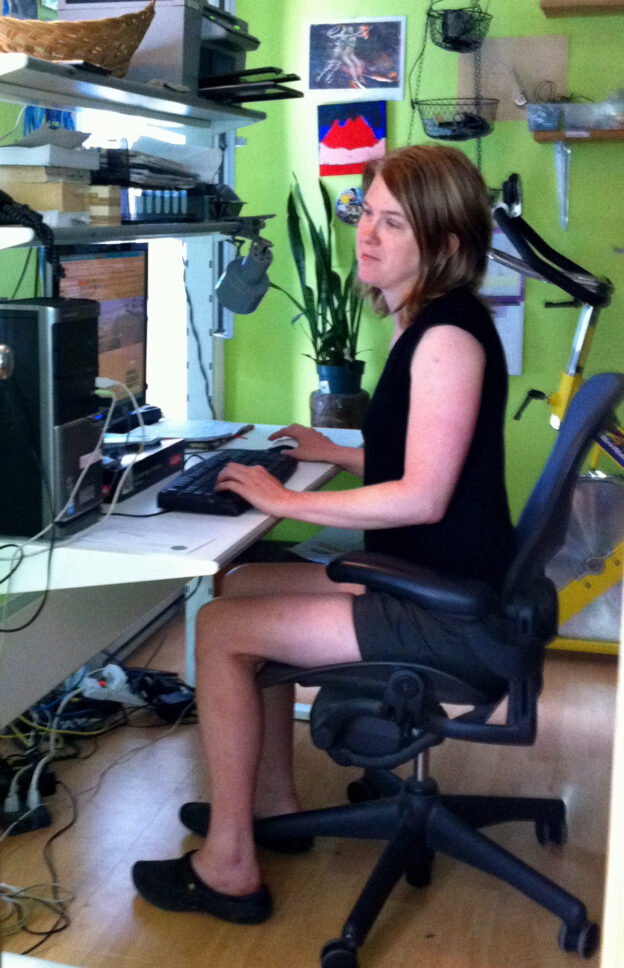
But now, when I look at my photo – compared to the diagram – I see I am too far forward in my chair, without proper back support. I’ll have to fine tune my setup – along with being mindful of my posture, stretching, exercising, and drinking more water and less coffee.
What more can I do?
Despite my efforts, I still get a bit of upper back stiffness, though nothing too bad. Maybe it strains muscles when I use my laptop and/or iPhone in my car or at a cafe because I have to tilt my head downwards to see their screens.
I’d like to ask an ergonomist what more I can do. How can I make my workstation even better? What’s an ergonomic way to use laptops on the go? Please share your suggestions or links.
Don’t overload kids’ backpacks
September 09, 2011
In the workplace, people who lift heavy loads should be careful to avoid overexertion injuries – and the same thing goes for kids carrying heavy backpacks.
For workers, WorkSafeBC offers a Lift/Lower Calculator to determine safe load limits. Kids, as a rule, should not carry more than 10 to 15 percent of their own body-weight in their backpacks.
But maybe some people don’t realize this, because I see lots of kids heading back to school wearing great, big backpacks. It seems like they are toting much more than I ever did at that age – and sadly, this can lead to chronic back problems later in life, according to a story in The Tribune (and many other articles on this important topic).
“When the development of the muscular system is messed up that can lead to having bad posture,” chiropractor Jacqueline Lightbourn told The Tribune. “Bad posture is the main contributor to low back pain, arthritis, disc problems and anything to do with the back, neck, and mid-back.”
Students need to stop transporting so many heavy things – and I’d like to see their parents, schools, and caregivers helping to coordinate this. People can brainstorm solutions and arrangements can be made.
Choosing the right backpack
The American Academy of Pediatric Surgeons recommends these features in a backpack:
* Wide, padded shoulder straps
* Two shoulder straps
* Padded back
* Waist strap
* Lightweight backpack
* Rolling backpack
For more information on choosing and using backpacks, check out:
Pack it Light, Wear it Right – includes a poster, pamphlets and fact sheets for distribution to children and parents (that can be customized for individual school districts) from the BC Chiropractic Association
BACK FACTS: Backpacks from the Canadian Chiropractic Association
Lightening the Load: Tips for Backpack Safety from Canadian Chiropractor magazine
Backpack Strategies for Parents and Students from The American Occupational Therapy Association
Backpack Safety Awareness from the Virginia Chiropractic Association
Online community for workplace safety
September 06, 2011
Check out safetycommunity.com – a social network for people in the safety community. It’s like a mini-Facebook, created on the Ning platform for people to ask questions, post links, share photos, and join discussion groups. I noticed discussions on ergonomics, construction, machine safety, mental well-being, e-learning, and more – dating back to 2009. It looks like a great tool for building a community of like-minded people from different geographic places – sponsored by Ansell (a company that makes protective gloves and condoms). So… see you there?
Building the Speaking of Safety community
While we’re on the subject of community-building, I’d like to say something about this blog. I really want people to leave comments on my posts.
I want to know what you think about the topics I bring up. Do you have more info, ideas, links, questions, disagreements, compliments? Please speak up. I’d love to hear from you! Remember you can always post without using your real name.
Odd way to change a light bulb
September 01, 2011
Here’s a story that reminds me of one of those jokes: How many [insert group of people] does it take to change a lightbulb?
In this case, it took one manager, two employees, and some fall protection gear – used innovatively. A worker told me about it via Facebook, after I posted a request for people’s stories about the most dangerous things they’d done at work.
“A light bulb burnt out on the underside of a catwalk approximately two stories up. We didn’t have a ladder, scaffolding, or a lift that was high enough to change the bulb, so my boss puts on a harness, we tie a rope to the D-ring, and two of us lower him down to change the bulb,” he wrote.
How dangerous is that?
I asked if his boss’s request seemed too dangerous at the time.
“It was sketchy, especially since my boss had a good 50 pounds more weight than I,” he wrote. “The two of us had to hold him in mid-air, below the catwalk, for the repair and replacement to be completed. Afterward, we lifted him back to the catwalk.
“It was a fall protection harness, but the rope was only being held by the two of us, not tied off. There was enough rope to reach the ground, about 30 feet down, but if we lost our grip, nothing would have helped. The rope was over-spec for the unusual demand and the railing was up to the task.”
Unusual indeed. I wonder what part of the WorkSafeBC Reg would be in violation if a worker were injured in this situation. Could someone please check for me? The details would not sound good on an incident report – that’s for sure!