Archive for July, 2011

To mask or not to mask

July 28, 2011

Image from WorkSafeBC Magazine

Recently I was at my favourite cafe. It’s small and strangers talk to each other a lot, which is one of the things I love about it (aside from the delicious coffee).

A construction worker came in, all caked in dust after a hard day’s work. He said he had been working beside a young guy using a jackhammer all day. That’s why his skin, hair, and clothing were covered in grey dust.

Considering my interest in workplace safety, I couldn’t help but ask: “What kind of respiratory protection were you using?”

He laughed scornfully and said, “They offered me a mask, but I just said: ‘Look at all this nose hair! I’m old [early 40s?] and I grow a lot of nose hair now, so I might as well use it for something!’” Read more

Slow down in the cone zone

July 26, 2011

Slow down in the Cone Zone

When you enter the “Cone Zone,” you should reduce your speed, pay attention, and be respectful of the roadside workers and their workplace.

That’s the message from Work Zone Safety Alliance. Their new roadside worker safety awareness campaign is aimed to protect thousands of workers on the roads – and I’m glad to see it!

We need as much attention as possible directed at this group of vulnerable roadside workers that includes municipal workers, landscapers, flag people, tow-truck drivers, road-construction and road-maintenance workers, telecommunications and utility workers, and emergency and enforcement personnel.

In the last 10 years, 386 WorkSafeBC claims were made by workers — typically working in Cone Zones — who were struck by motor vehicles. That’s way too many injuries, which is why it’s good to see all these organizations working together to reduce them:

* BCAA Road Safety Foundation
* BC Ambulance Service
* BC Construction Safety Alliance
* BC Flagging Association
* BC Hydro
* BC Landscape and Nursery Association
* BC Municipal Safety Association
* BC Road Builders and Heavy Construction Association
* FortisBC
* ICBC
* Ministry of Public Safety and Solicitor General
* Ministry of Transportation and Infrastructure
* Telus
* The Community Against Preventable Injuries
* Vancouver Fire and Rescue Services
* Lower Mainland police
* WorkSafeBC

For more info, or to download a campaign poster, visit Slow Down in the Cone Zone from WorkSafeBC. Drivers, please pay attention to this important message. Too often people speed through, thinking of where they are going, without caring enough about the people they pass. It’s time to change that!

Cold water shock can kill

July 21, 2011

Photo credit: Charles McCain on Flickr. Pictured is a member of the Spanish navy in the Atlantic.

Here’s a story of danger at sea from a federal agency officer who wants to be “on the low.”

I’ll tell you what he told me about his most dangerous workplace moment – without revealing his name nor that of his agency. The most dangerous thing he ever did at work was going out to sea in a Zodiac and boarding a huge ship. He did this as required – on rare occasions – as part of his duties as a federal public service manager.

“Some officers have better training – those more frequently on the water.” he said. “I might have felt like saying no – but frankly – I was thrilled to do it.”

I asked if he’d been trained to board ships at sea, but he said no. He had lots of training – firearms training, combat defence, and vessel inspection – but nothing specific to boarding ships at sea. He wore a life jacket and hung on tight.

“You can imagine it’s a very, very tall ship and to do that at sea, they typically slow down to about 6 knots in a rigid hull inflatable boat – a Zodiac – and they come along side of it,” he said, describing how he got from the Zodiac onto the ship. “They match the speeds and then they get close as they can get to it – usually within a metre or less. Then you go up a Jacob’s ladder – those cargo ladders you used in school, climbing up two or three storeys.”

The dangers of cold water

One major risk he faced was the cold water. If a wave hit him or he lost his grip, he could have fallen into the super-cold ocean and been vulnerable to cold water shock – which happens much more quickly than drowning.

“Cold shock occurs immediately — as you enter the cold water,” reads a WorkSafeBC bulletin, Cold Water Immersion.

Photo credit: Thomas Berg on Flickr

“It lasts three to five minutes but it can result in quick drowning because of the way the body reacts. You cannot control these reactions:

• A large intake of breath
• A rapid increase in breathing rate (up to four times as fast)
• A reduced ability to hold your breath (to as little as 10 seconds)
• A massive increase in heart rate and blood pressure.”

Thankfully this officer got on board the ship without incident – and now he has a quite a story to tell. Do you? Email susan@speakingofsafety.ca.

Impaired by lack of sleep?

July 19, 2011

Photo credit: nathansnostalgia on Flickr

Are you tired? If so, you aren’t alone.

Many of us sacrifice sleep for many of the same reasons – work, family life, socializing, social media. We know sleep is important, but we don’t make it a priority.

One study measures the effects of fatigue and compared it to blood alcohol content with the following results:

  • 17 hours awake is equivalent to a blood alcohol content of .05 (the legal limit in Canada)
  • 21 hours awake is equivalent to a blood alcohol content of .08
  • 24-25 hours awake is equivalent to a blood alcohol content of .10

“We live in a society where fatigue is a serious workplace health and safety issue,” reads a Human Factors Bulletin from WorkSafeBC. “Everyone can become fatigued. The best way to cope with fatigue is to prevent its onset.”

Sleep is the solution

More sleep is the obvious answer – 7.5 to 8 hours a night, ideally. We just need to convince ourselves that sleep is a high enough priority – just like this overworked airline executive in Grounded needs to do. This 20-minute video from the US Federal Aviation Agency shows how lack of sleep affects decision-making, behaviour, and quality of life. I would not want to live like the character in this film – whose problems can be experienced by people in any industry.

“Grounded” from Michael Curtis on Vimeo.

More info on fatigue and sleep hygiene

Work schedules and fatigue from WorkSafeBC

Shift work linked to higher risk of work injury: UBC study from Canadian Occupational Safety magazine

GUIDE TO SAFE WORK: FATIGUE MANAGEMENT from Enform, the safety association for Canada’s upstream oil and gas industry

Human factors: Fatigue from Britain’s Health and Safety Executive

Shift Work and Sleep from the U.S National Sleep Foundation

Photo credit: Craftology on Flickr

OHS Answers: Fatigue from the Canadian Centre for Occupational Health and Safety

Fatigue from the Canada Safety Council

Fatigue, Extended Work Hours, and Safety in the Workplace from Work Safe Alberta

Factors to consider when managing fatigue from Workplace Health and Safety Queensland

Safety contest for BC youth

July 14, 2011

Can you inspire your peers to work more safely in 25 words or less?

That’s the challenge for BC youth (13+) who want to become Raise Your Hand Champions in this contest that runs until August 31, 2011. One lucky entrant will win an Xbox Kinect prize package.

Participants get bonus entries (up to 20) when people “Like” their stories on Facebook. Their question: how did you raise your hand for safety at work?

The young worker experience

When I was a young worker at my first job, I cut my finger instead of raising my hand.

It was at a restaurant where my job was to clear tables and carry dirty dishes to the kitchen. One day a cook asked me to cut lemons with a knife that was much bigger and sharper than anything I’d ever seen in my family’s kitchen. I was scared to use it but I wanted to be helpful and didn’t want to “look stupid” so I ignored my own instincts, and cut a few slices of the lemon that wobbled precariously on the table. Within a moment, I’d sliced my finger and was headed for the ER where I got six stitches. Thankfully it wasn’t much worse. Read more

Forklifts right and wrong way

July 12, 2011

2011 BC Championship Forklift Rally

Soon I’ll have more news about the winners at the 14th Annual BC Championship Forklift Rally held on Saturday June 25th, 2011 in Cloverdale.

It’s a competition for forklift operators who work in or around the materials handling, distribution & logistics industry – testing their skills. I want to hear what it was like for the individual winners. How did they get so good at what they do?

In the meantime, I’ll tell you a story about some very unskilled forklift use. I heard it from a guy who worked in a warehouse full of industrial electric motor controls in the late 80s.

“I almost killed a guy,” said the worker, who asked to remain anonymous. “I tipped a 500-lb motor off the top of the rack with the forklift and it landed about a foot away from my coworker.”

How did the company follow up on this incident? They didn’t. It happened with two 20-year-olds alone in a warehouse. The guy’s coworker simply yelled: “Hey, be careful, dude!” and no further action was taken.

I asked if they had any training in using forklifts.

“Not really – just gas…brake…up…down,” he said.

It makes me angry to think about young people in this situation – untrained and unsupervised, using equipment that could potentially kill someone. But it’s good to see that times have changed, and there are programs like Raise Your Hand that remind young workers of their right to get proper safety training and refuse unsafe work.

Photo credit: Rosco Ellis on Twitter, fork lift in Texas

Today in BC, forklift operators are expected to be trained to a CSA (national) standard.

The young worker in this story could have used WorkSafeBC’s StartSafe Forklift Safety Tips – especially Forklift Safety Tip 2: Safe use of forklifts around other workers.

Regulations and related materials include

* WorkSafeBC’s Occupational Health and Safety Regulation, Section 16.4, Competency of operators

* Section 16.7, Standards

* OHS Guidelines G16.7(j)-1 and G16.7(j)-2

Common Factors in Forklift Accidents from the Canadian Centre for Occupational Health and Safety

Four tips for forklift safety from Canadian Occupational Safety magazine

Asbestos a hidden killer

July 07, 2011

Paul Douglas was exposed to asbestos while working as a boiler maker

Asbestos may be a silent killer, but this man affected by it was anything but silent.

Paul Douglas was diagnosed with mesothelioma and given three to six months to live. But he survived another 11 years and worked hard to raise awareness about his illness and exposure to asbestos. He wrote about his experiences in an online forum for others with his condition.

I read about Paul’s story at HiddenKiller.ca – a new website from WorkSafeBC and its partners. He’s one of the actual people behind the statistics associated with asbestos exposure – along with Dave Ford, an industrial electrician at a pulp mill, Anne Gerard, who was exposed to asbestos in tape she used at a denture clinic, and many others.

Anne Gerard

This website informs people re: what is asbestos, where is it found, what’s the danger, how should it be handled, and more. It even includes a knowledge-testing quiz. Mesothelioma, caused by asbestos exposure (that may have been decades ago), is BC’s number one occupational disease and leading cause of worker disease and death, according to WorkSafeBC.

Renovations seem to be happening all over the place, and since asbestos was used so much in building materials from the 50s to the 90s, everyone needs to pay attention. All workers have the right to know the situation in the buildings they work on and have access to suitable PPE. Workers and employers can learn more at the HiddenKiller website – and by checking out this WorkSafeBC video.

New construction safety signs in BC

July 05, 2011

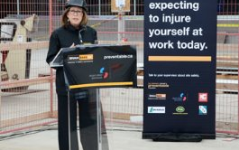
Construction safety sign in Vancouver

I stopped by the new BCIT campus under construction to check out the new safety signs unveiled on June 9 by WorkSafeBC and The Community Against Preventable Injuries (a.k.a. Preventable).

The new safety posters emblazon the sides of buildings, fencing, guardrails, and magnets on equipment – part of a joint WorkSafeBC–Preventable Construction Signage Pilot Project. The messages, with their bold white on black, aren’t just for people working on construction sites, but for everyone who sees them as they pass. They’re a reminder that we all need to stay safe, no matter what we do at work.

I walked around the perimeter of the site to get a good look at the signs and ended up chatting with some workers on the way back from their coffee break. I asked them to be in my photos, but they said no and joked around about how they would pose!

New construction safety signs in Vancouver at Stuart Olson Dominion's Broadway Tech

Focus on construction

They are focusing on this industry because it is so high-risk.

According to WorkSafeBC, there were 14,405 claims from construction worksites across BC in 2010. Of these, 7,620 were health-care-only claims, 6,014 were short-term disability claims, and 739 were long-term disability claims.

There were 32 fatal claims, and of those, 19 were due to occupational diseases.

Stuart Olson Dominion’s Broadway Tech Centre #4 is one of eight sites participating. Five are in the Lower Mainland, and the others are in Esquimalt, Kamloops, and Prince George. The other employers are ITC Construction Group, Kindred Construction Ltd., Lafarge Aggregate & Concrete, and PCL Construction.

Thanks to all for spreading the word in such a visible way. For more information on construction safety, please visit the BC Construction Safety Association.