Archive for March, 2011

On a slippery slope without fall protection

March 31, 2011

Photo: Andy Bullock on Flickr

In the 1990s, my brother Bob worked in the Vancouver film industry as a production assistant. At that time, he was in the “young worker” category (15 to 24 years old) and eager to please. In that job, he could be replaced with a moment’s notice. One of his friends had been fired for buying the wrong type of doughnut.

Bob told me about an experience that makes me angry to think about because it’s so dangerous. Thankfully he wasn’t hurt, but it’s still a good example of worst practices.

“I once stood on a slippery roof holding a piece of plywood while a massive snow gun shot fake snow at me to create the illusion of winter,” he told me via Facebook, in answer to my question: “What’s the most dangerous thing you’ve ever been asked to do at work?”

“It was almost impossible, but took every ounce of strength I had to not go flying,” he said. “I think weird stuff like that happens all the time in film because there’s a sort of unwritten thing relating a bit to ‘the show must go on’ or ‘whatever it takes’ mentality in that part of the arts.”

Improved standards for safety in film

Today in BC, we have Actsafe, the health and safety association for British Columbia’s motion picture and performing arts industries. I’m sure the folks at Actsafe would not be happy to see what my brother was asked to do at work. It makes me angry to think of him in that situation, not wanting to lose his job, and doing something so dangerous. He left the industry years ago, but for the many who remain, I hope they are not put in such hazardous positions.

Ventana Safety Day

March 29, 2011

Ventana staff get hands-on - reviewing proper use of fire extinguishers. Photo credit: Ventana Construction

Recently I was invited to Ventana Construction‘s Safety Day 2011 – a mini-conference that brought together more than 30 workers for courses, certification, and a lot of laughs.

“We have many construction sites and our employees are spread out and rarely get a chance to see each other in a large group,” said Stephen Bertoia, Ventana’s project manager/safety coordinator. “I wanted to get everyone from the sites together for one event.”

Stephen said he got the idea of holding the event after attending the Bridging the Gap safety conference for the construction industry in November. He said he liked the courses offered at the construction safety conference, so he talked to safety vendors about setting up at a conference at Ventana’s headquarters in Burnaby. Read more

A century ago: NYC’s deadliest workplace accident

March 24, 2011

On March 25, 1911, 148 people died at work – trapped by a fire in the Triangle Shirtwaist Factory in New York City.

“When a tossed match or lit cigarette ignited a fire on the eighth floor of the building, flames spread quickly,” reads the PBS website.

“Blanck and Harris [the employers] received warning by phone and escaped, but the 240 workers on the ninth floor continued stitching, oblivious to the flames gathering force on the floor below.”

This tragedy “forever changed the relationship between labor and industry in the United States. Within three years, more than 36 new state laws had passed regulating fire safety and the quality of workplace conditions.”

I’ve been watching YouTube videos with interviews of people who were there. The majority were women, nearly half were teenagers, and many were new immigrants.Those workers were trying to support families for a low wage from an employer who locked them in to prevent theft and left them to die. Let’s remember them.
You can watch the documentary online at the PBS website.

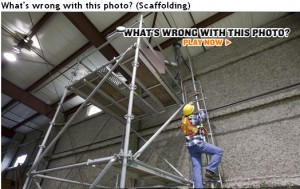
Play online: “What’s wrong with this photo?”

March 22, 2011

Challenge from WorkSafe Magazine, March/April 2011

There’s a certain appeal in pointing out other people’s errors. This is evident when you look at the popularity of “What’s wrong with this picture?” which I wrote about in September 2010.

In that post, I said I was impressed to see how WorkSafe Magazine had engaged people from around the world with this bimonthly photo challenge from their print version – getting answers from as far away as Africa, Poland, India, Ireland, and the UAE.

Now the challenge is available online in a new, interactive format that can be shared more easily through social networks and email. Play by March 28 to enter a prize draw and have your answers published in the next issue of WorkSafe Magazine. You can also go back and check your danger-spotting skills on past issues.

WorkSafeBC invites you to play now.

Care aides guard public from violent clients

March 17, 2011

Photo credit: Radio.Guy/Adam on Flickr

Here’s a story from a former care aide attendant who worked in a group home for young and middle-aged adults. Residents at the group home lived with cognitive and physical disabilities, mental illness, and dual diagnosis (i.e. addiction and mental illness together).

“As far as safety goes, it’s a tough slog, that’s for sure,” said my friend, who I’ll call Joan.

Some aspects of the job were rewarding, but there were also many risks, such as exposure to bodily fluids, getting bitten, overexertion from lifting people, and emotional stress. Yet in addition to watching out for their own safety, Joan and her coworkers had to take special precautions with residents whose behaviours could endanger the public. Read more

Reporting unsafe conditions

March 15, 2011

Photo credit: Frédéric Bisson/zigazou76 on Flickr

Today I have a safety hero tale for you. It comes from my friend Christine Saruyama, whose quick thinking and action probably saved a couple of lives. I’ve been collecting stories of danger from my contacts on Facebook and Twitter, and this one really stood out to me.

Years ago, Christine was working at a car dealership when she walked outside and found two coworkers in danger of electrocuting themselves.

“I went out the doors to find the two lot attendants ‘fixing’ an electrical cord. It was raining and they were standing outside in a puddle of water with the cord plugged into the wall outlet,” Christine wrote. “The casing for the plug part itself was completely cracked open, hanging in two pieces, and they were trying to tape it together so they could use it to plug in the vacuum cleaner.” Read more

Blog shows people behind statistics

March 10, 2011

Memorial photo from the USMWF website

The Weekly Toll: Death in the American Workplace is a memorial blog that tells the stories of people who die at work in the United States.

Up to 16 Americans die at work each day and the United Support and Memorial for Workplace Fatalities formed to remember them and lobby for improved safety conditions.
“Our lost loved ones were the very ones making your profit. We are not asking for more than we are entitled to, Our Right, The Right to a Safe and Healthful Workplace,” reads the USMWF’s website.

“We are the brothers, sisters, mothers, fathers and children of America. Families and their losses are not a number or a statistic.” Read more

“My how things have changed!”

March 08, 2011

Asbestos in plaster

That’s the word from one of my safety contacts in the UK who emailed an answer to my question: “What’s the most dangerous thing you’ve ever been asked to do at work?”

Back in 1975, he was a trades apprentice renovating a school built in 1950.

“I was given a damp cloth to cover my mouth, and a large hammer and told to smash down the ceilings in the corridors to make way for the new replacement ceiling,” he wrote. “The old ceiling was completely made up of asbestos boarding! My how things have changed!”

Very true. Today there are strict procedures for dealing with asbestos. A wet cloth over your mouth is a far cry from what’s required by the Occupational Health and Safety Regulation here in BC.

Here in my jurisdiction, OHS Regulation Part 8 Personal Protective Clothing and Equipment calls for full facepiece powered air-purifying respirators with HEPA 100 filters.

More asbestos resources

Many other organizations work to protect workers against asbestos exposure. Their offerings include the following:

OHS Answers: Respirator Selection from the Canadian Centre For Occupational Health and Safety

Safe Work Practices For Handling Asbestos from WorkSafeBC

Health Risks of Asbestos from Health Canada

Asbestos from the Canada Mortgage and Housing Commission

Today my UK contact is a health and safety consultant who advises companies, and I thank him for sharing his shocking story. If you have a story of workplace danger to share, please email me at susan@speakingofsafety.ca.

This video – Overview of Asbestos Removal Procedures US 1999 – was produced by the US Environmental Protection Agency.

Walk to remember

March 03, 2011


Steps For Life is a fundraising walk to raise money for families who lost loved ones in workplace tragedies. On April 30 or May 1, 2011, people in 33 Canadian communities will walk together and remember the human faces behind the statistics.

“We set up pictures and stories, on the walk, of people who have died throughout the year. As you’re walking you get to read the real person’s story,” said Tanya Steele – one of the organizers of Metro Vancouver’s second annual Steps For Life walk on April 30.

“It’s recognizing the reality of how many people are actually killed at work. I think it’s important for people to understand that people are still dying at work. That is ridiculous. People shouldn’t be dying at work,” said Tanya, director of training and client services at ER Plus Risk Management Group in Richmond.

I met Tanya at the NAOSH Week awards last fall and called her recently to see what she’s working on these days. She told me about her volunteer work with Steps For Life, a project she’s doing with two of her coworkers and other volunteers from the Canadian Society of Safety Engineers and Threads of Life – a national organization formed in 2003 by grieving family and friends.

ER Plus is supplying first aid services for the Metro Vancouver walk – and local sponsors are still needed for contributing food and other donations to this family event that marks the start of NAOSH Week. Last year, it was mainly adults, but organizers are hoping more kids will attend this time. They might even get a bouncy castle!

Interested sponsors can email Tanya at tsteele@erplus.com.

Refusing unsafe work

March 01, 2011

Photo credit: AshtonPal/That Boy on Flickr

“Have you ever said no to a supervisor because something seemed too dangerous?”

I posted this question on Facebook and got some interesting responses. I’ll share them with you in the coming weeks, and start with the craziest one. It’s from a friend I’ll call “Hank” – who said “no” to his supervisor at a warehouse about 10 years ago when he was asked to do something foolishly dangerous!

The supervisor had asked Hank to stand on a pallet and be lifted by forklift to fix a loose air venting pipe near the ceiling. Hank refused.

“I am not afraid to stand up to employers who are goofs and treat the worker like crap,” Hank told me, via Facebook message. “And if they don’t like it, I leave. I quit that job and a few others too, for good reasons. Read more